
 My husband writes music reviews, which means I have the opportunity to hear a lot of good music...and a lot of, well, music that I don’t love. I also get to stare at Mark in awe as he confidently describes albums as “angular artrock” or “Japanese instru-metal.” Angular WHAT? Japanese HOW? It is strange to hear someone you know so well put together phrases that you completely and utterly don’t understand.
Food imagery is rarely as impenetrably obtuse, but the craft of describing food and describing music are not that dissimilar. Both involve allusions and metaphors, evoke your senses, and, in the end, reflect just as much about the describer as the described. Although I usually lack the vocabulary and reference points to express more than a gut-level like or dislike of music, I occasionally try to impress my husband by, for example, telling him that a singer-songwriter sounds like what would happen if Iron & Wine shouted instead of whispered. Could fool you into thinking I know what I am talking about, now couldn’t I?
Mark, in return, shares his insights about food. Like when, after tasting this soup from Morocco, he quickly exclaimed – “It’s like grown-up Spaghetti-Os!” Sweetened by squash, freshened with lemon, and sustained by dainty pasta strands instead of Os – why yes, yes chorba bil matisha does taste a bit like grown-up Spaghetti-Os. Although this easy-to-prepare Kitty Morse recipe may not be as thought-provoking as angular artrock or Japanese instru-metal, it deftly transcends the seeming average-ness of pureed tomatoes and squash through the inspired addition of cilantro, celery leaves and cloves. Like new music from The Old Ceremony, Roman Candle, Sara Bareilles, Bobby Bare Jr., The Be Good Tanyas, and The Crooked Jades, it will join our regular playlist.
Chorba Bil Matisha
Adapted from The Vegetarian Table: North Africa
Serves 4 generously
1 onion
4 whole cloves
6 cups / 1.5 liters vegetable broth
2 pounds / 1.2 kilograms butternut squash, peeled, seeded and cut into small chunks
4 celery stalks, including leaves, coarsely chopped
5 tomatoes, quartered
12 fresh cilantro (a.k.a. coriander) sprigs
¼ teaspoon / 1.25 milliliters ground turmeric
½ cup / 50 grams angel hair pasta, broken into 2-inch / 5-centimeter pieces
½ cup / 125 milliliters milk
Salt and freshly ground black pepper, to taste
Lemon wedges
Stud the onion with the cloves. In a large saucepan, combine the onion, broth, squash, celery, tomatoes, cilantro and turmeric. Cover and bring to a boil. Reduce heat to medium and cook until the vegetables are tender, 30-40 minutes. Take the pot off of the heat and discard the onion with its cloves.
Use an immersion blender to puree the vegetables and broth until smooth. Return to heat and add the pasta. Simmer until the pasta is tender, about 6-8 minutes. Turn off the heat, stir in the milk, and season with salt and pepper. Serve immediately, with lemon wedges.
Sunday, October 07, 2007
Grown-up Spaghetti-Os
Sunday, March 18, 2007
Cooking Stew, Reminiscing Too
 You cannot read Colette Rossant’s Apricots on the Nile: A Memoir with Recipes without envying the stunning array of Egyptian and French food – from simple street food to elaborate wedding-day specialties – that she enjoyed as a child. Nor can you help admiring Rossant’s vivid memories of how these favorite dishes wove themselves in and out of her daily life. You also can’t avoid pondering what recipes might form the culinary unpinning of your own memoir.
Slightly adapted from Apricots on the Nile
Serves 4 as a main course
1 liter/ 4 cups vegetable broth
2 large onions, chopped (divided)
1 large tomato, chopped
1 carrot, chopped
2 small zucchini, chopped
1 teaspoon ground cumin
150 grams / 1/3 pound angel hair or vermicelli pasta, broken into small pieces
Salt and freshly ground black pepper, to taste
30 milliliters / 2 tablespoons olive oil
30 milliliters / 2 tablespoons fresh parsley, chopped
Saturday, January 20, 2007
Soup for a Rainy Season
 It is easy to overlook the wonder of rain. Beyond the fact that it emerges from moving, ominous grey things called CLOUDS and falls from the SKY (two awe-inspiring features, if you ask me), there is also the breath of cool air that foreshadows its first drops, the sound rain makes on different objects (a tin roof, a pool, a window pane), and the moist, earthy smell that land somehow conceals until rain comes, just like bread hides the smell of toast.
I’ve always enjoyed rain. After all, if the weather was beautiful everyday, when would I play cards, watch two movies in a row, bake cookies, organize photos, paint my fingernails, or write long e-mails? Rain gives you permission to be cooped up and sedentary, and to ponder, over a bowl of soup, how to make the best out of the situation.
We had invited two friends over for tennis and a light lunch, but the rain nixed the tennis, as well as my enthusiasm for the green salad I had planned on serving alongside a chard and saffron tart. Soup was in order, and Tunisian Tomato Soup is the prefect choice for a cool, drizzly day, combining all the comforts of tomato soup with the heartiness of lentils and chickpeas, a sunray of lemon, and classic Tunisian accents of cinnamon, turmeric, cayenne and raisins.
Let it rain!
Adapted from Mollie Katzen’s Vegetable Heaven
Serves at least 8 as a starter
1 cup brown lentils, rinsed and picked over
1 cinnamon stick
6 cups / 1½ liters water
2 tablespoons / 30 milliliters olive oil
4 medium onions, chopped
2 cloves garlic, minced
2 teaspoons / 10 milliliters salt
1 teaspoon / 5 milliliters ground turmeric
1½ teaspoons / 7½ milliliters cumin seeds
2 teaspoons / 10 milliliters ground cumin
3 bay leaves
1 28-ounce / 800-gram can crushed tomatoes
1 14-ounce / 400-gram can chickpeas, rinsed and drained
3-4 tablespoons fresh lemon juice
Cayenne pepper, to taste
Salt and freshly ground black pepper, to taste
½ cup raisins, soaked in warm water and drained
Monday, January 15, 2007
African Peanut Stew, Organized
 I used to be organized. I really was.
And, so, I love African Peanut Stew. You could probably throw any vegetable in here and it would taste just fine. Eggplant, corn, green beans, squash, peas, tomatoes – bring it on. Even tofu would be a welcome addition. I made this recipe last night with what I had in my fridge. This included some dried shrimp that a friend brought us back all the way from
Serves 4
1 medium onion, chopped
1 large leek, white part only, well-cleaned and thinly sliced
2 garlic cloves, minced
1 teaspoon fresh ginger, grated
2 teaspoons ground cumin
2 teaspoons ground coriander
2 medium sweet potatoes, diced
1 carrot, diced
2 green chilies, deseeded (if you wish) and minced
1½ teaspoons salt
2 cups vegetable broth
1 medium pineapple, peeled, cored and cut into chunks
1 green pepper, diced
¼ cup dried shrimp/prawns (optional)
½ cup smooth, natural peanut butter
½ cup crushed peanuts, toasted
 This post in an entry in the inaugural Waiter, There’s Something in My…, a monthly food blog event organized by Cook Sister!, Passionate Cook and Spittoon Extra. Janaury's theme is stews.
Sunday, December 10, 2006
Ful Medames, the Holiday Antidote
 Eggnog, cheese balls, shrimp dip, trifle, fruit cake – there is no doubt about it, the closer we get to the holidays, the richer and heavier our food and drink becomes. Following a festive evening, what I really want to eat is an antidote to all that gluttony. Something nutritious, comforting and uncomplicated that resets my body’s balance and allows me to face another Christmas party buffet, plate in hand.
Serves 4 as a light main course
2 tablespoons olive oil
1 onion, chopped
2 garlic cloves, crushed
1 teaspoon ground coriander
1 teaspoon ground cumin
½ teaspoon cayenne pepper
2 bay leaves
1 large tomato, peeled and chopped
4 cups vegetable stock
2 15-ounce cans fava beans, rinsed and drained
2 tablespoons lemon juice
2 tablespoons tahini
¼ cup fresh parsley, chopped
1 teaspoon salt
Salt and freshly ground pepper, to taste
4 hard-boiled eggs, chopped
3 scallions, sliced
Cilantro leaves, for garnish
This post is an entry in the Super Souper Challenge, a food blog event hosted by running with tweezers.
Tags:
Saturday, October 21, 2006
From Nigeria: A Fish Stew
 Last December I spent 10 days eating (and working) in
By the end of the trip, I had identified several favorite dishes. First, there was moin-moin – a steamed cake of ground legumes studded with tiny fish and hard-boiled egg, and dyed a lovely rose color from the use of palm oil. I’d usually order moin-moin with a side of dodo, which are fried plantains similar to the ones you’d eat at a Cuban restaurant. I also enjoyed a wide variety of fish stews and soups.
Adapted from Food by Country and Motherland Nigeria
Serves 4
2 teaspoons salt, or more, to taste
1 tablespoon dried thyme, or more, to taste
1 small red bell pepper, chopped
1 small green chili, minced
1 small onion, chopped
½ cup tomato paste
2 cups vegetable broth
3 tablespoons vegetable oil (palm oil, if you have it)
Salt and black pepper, to taste
Season the fish fillets with salt and thyme, and set aside. Place the red pepper, chili, onion, tomato paste and broth in a medium saucepan over medium heat. Bring to a simmer, and cook for 10 minutes. Add the oil and turn the heat down to low. Cook for 15 minutes. Slice the fish into ¾ -inch strips, and add them to the pot. Simmer for 10 minutes more. Add salt and pepper to taste, and serve the stew over rice.
Friday, October 06, 2006
Faves on Fridays #1: Curried Tomato Soup
 Mark, my husband, tucking into a plate of sweet tomato and baked ricotta pasta: “You should really post on your blog about some of our favorite recipes. You know, like this pasta.”
Mark, a week later, dipping his spoon into a cream-topped serve of fruit crumble: “See, here’s another one – another of our favorite recipes that we make all the time. I’m sure people would like this – you should post the recipe on your blog.”
Mark, just the next day, ladling spicy mushroom and cilantro curry onto a plate of cardamom-scented basmati rice: “Come on, Carolyn! Mushroom and cilantro curry. You’ve got to write about mushroom and cilantro curry!”
Okay, okay. I get the point. And, instead of changing the sub-title of Field to Feast to “Almost-always African-inspired writing, cooking and eating, and with an occasional post inspired by the dog-eared pages of my cookbooks” I have decided to introduce a new, occasional blog feature – Faves on Fridays.
My one reservation in posting this inaugural Fave on Friday is that you might think I am on a liquid diet given the number of drink, soup, stew and chowder recipes I have recently written about. Fear not, I have all my teeth and do eat solid food. However, my first recipe is, indeed, a recipe for soup. A tomato soup in fact. But, once again, fear not: this is not
The recipe comes from Madhur Jaffrey, one of my favorite authors, who says it is inspired by an old Anglo-Indian cookbook. This soup also has many features my husband admires – you can be flexible with the veggie proportions, your chopping can be haphazard, and you just throw everything together, go for a jog (do yoga, watch TV, call your Mom, whatever), re-enter the kitchen, blend the now-tender mixture, and eat. Plus, you have leftovers for lunch the next day. Yes, this is truly a Fave.
Curried Tomato Soup
Adapted from World Vegetarian
Serves 6
2 tablespoons peanut or canola oil
1 medium onion, chopped
1 tablespoon mild curry powder
1 tablespoon hot curry powder
2 cups (1 pound) chopped tomatoes
2 medium carrots, chopped
2 medium potatoes, peeled and chopped
1 cup fresh (or frozen and defrosted) peas
4 cups water
2¼ teaspoons salt
½ cup heavy cream
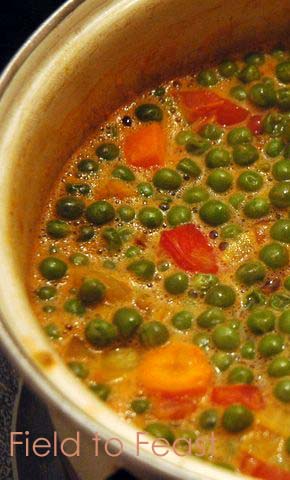
Heat the oil into a large saucepan, using medium-high heat. When the oil is hot, add the onion and sauté for 5 minutes or so, until the onion is translucent. Stir in the curry powders, and then add the tomatoes, carrots, potatoes, peas, salt and water. Bring to a boil. Cover, turn the heat down to low, and keep at a gentle simmer for 45 minutes.
Remove the pot from the heat and blend the soup using an immersion blender. Stir in the cream, and serve.
Note that you can use the curry powder judiciously to make the soup as mild or spicy as you would like – we tend to like a lot of heat.
Wednesday, September 27, 2006
From Mozambique: A Simple Soup
 Several people have described reading Field to Feast as a form of “armchair traveling” to a faraway continent. While I am quite happy for my blog to virtually whisk you away, I have to be honest – I live in only one of the 53 countries in
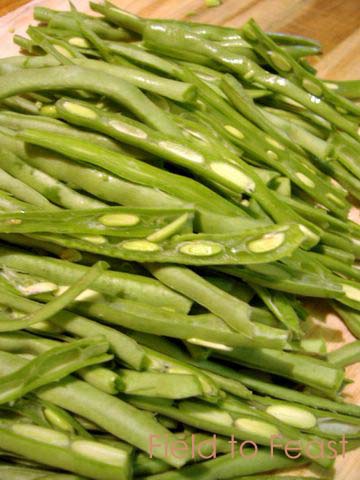 Sopa de feijao verde is a simple, elegant soup, with a peppery kick. It is certainly not the type of soup that can substitute as a one-pot meal, but it would make a lovely starter for a Sunday lunch in autumn or spring. There is something inherently graceful about long, slender green beans, and they take center stage in this recipe. However, there is nothing (slurp! splash!) graceful about trying to eat long, slender green beans with a soup spoon. In the recipe below, I have recommended cutting most of the string-bean pieces down to bite-size, while leaving a few long ones to artfully arrange on the top of your serving bowls or cups. You could also steam or blanch these longer beans separately, if you choose.
String Bean Soup (Sopa de Feijao Verde)
Adapted from The African Cookbook
Serves 4-6 as a starter
2 medium potatoes, cut into ¾-inch chunks
1 medium tomato, chopped
1 large onion, chopped
¼ teaspoon black pepper
1 teaspoon salt
½ pound string beans
Saturday, September 09, 2006
Ethiopian Lentil Stew and an Analogy
 If you went to college in the States, you are sure to shudder at the memory of analogies. Analogies are the word pair bane of your existence that, until 2005, dominated the verbal section of the SAT – the entrance exam required by most colleges in the country. For some reason, the exam writers believed that students’ ability to understand the relationship between two words was an effective way of predicting future academic success. The test would provide a word pair, such as “chef : food,” and you needed to review a list of other word pairs and ascertain which of these pairs shared a similar relationship to the given pair. In this case, “carpenter : wood” would do, for example. Chef is to food as carpenter is to wood. Clear as mud, yes?
Not surprisingly, I have spent nary a second thinking about analogies since I took the dreaded SAT. That is, until I embarked on a search for a recipe for yemiser w'et, an Ethiopian lentil stew. Every recipe reminded me of Russian nesting dolls because in order to make the main recipe, you first had to make at least two other, smaller recipes. Ergo:
“Russian nesting dolls : Ethiopian lentil stew” as “Recipe : Dish.”
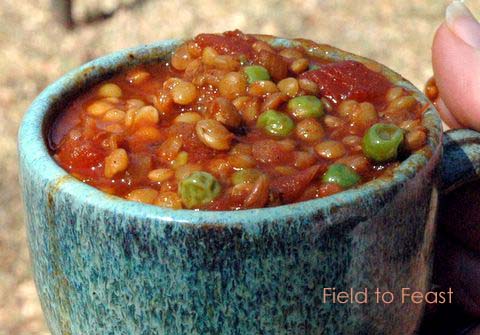
 The yemiser w'et recipes I found all required berbere (a spice mixture) and niter kebbeh (spiced ghee). Now, I don’t know about you, but berbere and nitar kebbah aren’t usually on the shelf at my local supermarket. After consulting with Recipe Zaar and Food and Home Entertaining, I combined recipes for these two ingredients with several recipes for the main dish to develop the one consolidated yemiser w'et recipe below. It looks more complicated than it actually is – many of the ingredients are spices that you simply measure and add. Once finished, you’ll have a delicious, spice-infused tomato, lentil and green pea stew. One recipe, one dish. No Russian nesting dolls.
Ethiopian Lentil Stew (Yemiser W'et)
Serves 8
SPICED GHEE
½ cup ghee (use vegetable oil as a substitute)
2 tablespoons chopped onion
1 garlic clove, minced
½ teaspoon fresh ginger, grated
¼ teaspoon turmeric
2 cardamom pods, crushed
1 small cinnamon stick
1/8 teaspoon fenugreek seeds
3 leaves fresh basil
LENTILS
2 cups dried brown lentils, picked over
4½ cups water
BERBERE
3 teaspoons cumin seeds
1 teaspoon ground cardamom
¼ teaspoon whole allspice
1 teaspoon fenugreek seeds
1 teaspoon coriander seeds
8 cloves
1 teaspoon black peppercorns
15 dried red chilies, crushed
¼ teaspoon ground ginger
¼ teaspoon ground cinnamon
1 teaspoon ground turmeric
3 tablespoons plus 1 teaspoon sweet paprika
1 teaspoon salt
STEW
2 cups onions, chopped
4 cloves garlic, minced
4 cups tomatoes, chopped
1 cup tomato paste
2 cups vegetable stock
2 cups fresh green peas (or frozen peas, defrosted)
Salt and pepper, to taste
 Put the ghee in a small fry pan over medium heat. Add all the ingredients listed and turn the heat to low. Simmer for 30 minutes.
Meanwhile, rinse the lentils and put them in a pot with the water. Bring to a boil, lower heat to a very gentle simmer, and cook, partially covered, for 25 minutes or until tender. (If the lentils are tender and there is still water remaining in the pot, simply drain.) Set the lentils aside.
Next, prepare the berbere. The spice mixture is very strong, so it is a good idea to open all the windows in the kitchen; otherwise, you may have a coughing and sneezing fit. Put a fry pan over medium-high heat and add all the spices listed (except the salt). Cook for 2 minutes, stirring constantly. Add the salt, and grind all the spices in a spice grinder, or with a mortar and pestle.
At this point, your ghee should be almost ready. Strain the mixture using a cheesecloth and discard the solids. Return the newly-spiced ghee to medium heat in a large saucepan, and begin to make your stew. Add the onions and garlic to the spiced ghee and sauté until the onions are just translucent, about 5 minutes. Add 3 teaspoons of the berbere (saving the rest for the next time you make this dish!) and sauté for a few minutes more, stirring occasionally to prevent burning.
Mix in the chopped tomatoes and tomato paste and simmer for another 8 minutes, stirring occasionally. Add the vegetable stock and the cooked lentils, and continue simmering and stirring for 10 minutes. Add the green peas and cook for an additional 5 minutes. Season with salt and black pepper, and you are finished!
Yemiser w'et is typically served with injera bread – the Ethiopian mealtime staple made with teff, the smallest grain in the world. This bread always reminds me of an undercooked pancake, which is not a good thing. So, as an alternative, I served the lentil stew with some Indian rotis we had on hand. Pita bread or tortillas would also work well. Since the stew is often accompanied with yogurt or cottage cheese, I spread smooth cream cheese on the rotis, and we used them to scoop up the stew.
“Chili : Spicy” as “Yemiser w'et : Yum.”
Wednesday, September 06, 2006
Botswana Chow-da

Blessed with these
Adapted from Quiet Food: A Recipe for Sanity
Serves 4
3 fresh ears of corn or 1 can of corn kernels, drained
1 cup vegetable stock
1 tablespoon vegetable oil
1 teaspoon mustard seeds
6 curry leaves (optional)
2 centimeters / ¾-inch fresh ginger, grated
2 cloves garlic, pressed or minced
1 stalk of lemongrass, lightly crushed
2 green chilies, cut in half lengthwise, with seeds removed
2 cups plain yogurt
4 tablespoons smooth peanut butter, smooth
1 teaspoon honey
3 teaspoons corn flour, mixed into 4 tablespoons of water
Salt and pepper, to taste
Fresh, chopped cilantro (a.k.a. coriander), for garnish


