Showing posts with label Egypt. Show all posts

Sunday, November 18, 2007

Good, Simple, Filling

Cookbooks are filled with gussied up classics – cheesecakes transformed by lite makeovers, chocolate chip cookies enriched by whole grains, grill-side marinades renewed with pomegranate molasses, macaroni and cheese gourmet-ed with gruyere, and mashed potatoes, anointed by truffle oil, baptized into 2007. When I first made kushary, a sturdy Egyptian dish built around lentils, rice and pasta, I, too, was tempted to play. What if I added some a cinnamon stick to the stewing lentils, or mixed in some roasted garlic? There, in that pan of simmering tomato sauce, couldn’t I toss in a dried chili and some fresh herbs? And wouldn’t using spinach pasta just brighten up the whole dish?

Why, yes, it probably would. But sometimes cheesecake is supposed to be fattening; mashed potatoes need to be, well, just mashed potatoes; and kushary should be left as the simple, stick-to-your-ribs, working-class meal that it is.

Even on the night just before you go grocery shopping, you will be able to make kushary. Pasta, rice, lentils, tomato paste, onions – is this not a concise list of staples? I’ll admit, the current
food shortages in Zimbabwe and recent multi-day power outages at my house have created some challenges for a food blogger. (Did I mention I haven’t had a dial tone at my house for a month and, yes, I use a modem?) All the more reason to keep it simple, be happy that your refrigerator is reasonably full (although where oh where can I find real butter?), and remember that food is for sustenance. When it tastes good, even better.

Kushary tastes good. Not phenomenal or awe-inspiring. It is not the type of food you eat slowly because you are pausing every half-second to gush with praise. But it is good. The recipe I use comes from Clifford Wright, who has an excellent site you should explore when you have the time. The whole compilation – pasta on the bottom, rice and lentils in the middle, sauce poured on top, garnished with browned onions – improves the next day.

Rather than rewrite the recipes, here are the links:

Here for the
kushary,

And here for dim’a musabika, the thin tomato sauce it must be made with.

I left my onions caramelized instead of crispy, mostly because I find the line between crispy and burnt very hard to master. And, yes, I did use ghee – I found an old container crammed into a dark recess of my fridge. The serving numbers are accurate – it fed my husband and me exactly three meals. Three good, simple, filling meals.

Thursday, April 19, 2007

After a Pause, A Pudding

Greetings from cold, rainy Boston, Massachusetts. Yep, that’s right, I am away from Zimbabwe for the moment and am visiting family and friends in the U.S. I thought I would have lots of free time during my trip, free time during which I would cook many delectable African dishes that would win the admiration of many wary-eyed family members, and that I would transform into many wonderful blog posts. The reality: few items have been cooked and, until now, no posts have been written. Instead, I have been wooed by shopping malls and feted by friends, spent hours of drop-jaw gawking at the amazing offerings of Trader Joe’s, Whole Foods and Wilson Farms, and been re-introduced to the joys of surfing with a fast (as opposed to a 32kbs) internet connection. Ah, the many wonders of the (over)developed world.

I have squeezed in a bit of cooking – not the elaborate feasts I had a mind, but a few dishes here and there, including
these beans, this stew and beetroot pesto pasta. The biggest admirer of every dish has been my 16-month old nephew, who, I’ve learned, will eat and drink absolutely anything. I have seen him gobble up pickles and clams, bite into a fresh lemon, and take a sip of black coffee – and go back each time for another gobble, bite and sip. He may not be discerning, but he is certainly the most adventurous little eater I have ever seen. (Here seen eating the aforementioned pasta).

Thus, it was not surprising that Little Matthew used two hands as he devoured the apricot pudding I made using a recipe from Colette Rossant’s
Apricots on the Nile: A Memoir with Recipes. This dish had other family fans, too, including my mom, who was seen eating a bowl for breakfast and claimed the pudding’s intense apricot flavor become better every day. This dish is a great springtime dessert because of its sunny yellow color – I wish I had made it for Easter, in fact. The most fun part of this recipe is seeing how the dried apricots, after being soaked overnight, actually plump up until they are almost the size of fresh apricots. I was amazed!

Without further ado, here is apricot pudding, a recipe I hope will tide you over until I return to Zimbabwe in mid-May…or until I somehow sneak away from the many distractions vying for my attention to cook and write another post!

Apricot Pudding
Slightly adapted from
Apricots on the Nile
Serves 6 or more

450 grams / 2 cups dried apricots
6 large eggs
90 milliliters / ¼ cup plus 2 tablespoons heavy cream
30 milliliters / 2 tablespoons rum
150 grams / ¾ cup sugar


Place the pound dried apricots in a bowl, cover them with warm water, and soak overnight. Drain.

Pre-heat the oven to 180° C / 350° F. Place the apricots, eggs, heavy cream, rum and sugar in a food processor. Process until the apricots are puréed. Butter a 1½ liter / 1½ -quart mold, and pour the apricot purée into the mold. Place the mold in a larger pan filled with hot water. Bake for 50-60 minutes, or until the point of a knife inserted in the middle of the pudding comes out clean. Cool.

I’m sure this is pudding heresy, but I didn’t unmold the pudding after it cooled; instead, I served scoops straight from the mold. Unmold if you wish! Rossant suggests garnishing with mint leaves.

Sunday, March 18, 2007

Cooking Stew, Reminiscing Too

You cannot read Colette Rossant’s Apricots on the Nile: A Memoir with Recipes without envying the stunning array of Egyptian and French food – from simple street food to elaborate wedding-day specialties – that she enjoyed as a child. Nor can you help admiring Rossant’s vivid memories of how these favorite dishes wove themselves in and out of her daily life. You also can’t avoid pondering what recipes might form the culinary unpinning of your own memoir.

Today, as I prepared Soeur Leila’s Red Lentil Stew – one of the book’s 43 recipes – I reflected on just this question: what recipes might help me tell the story of my childhood? Surely, this was too big a question to fully answer on a lazy Sunday afternoon. Even so, a rush of scents and flavors and recollections flooded into my head. In fact, I’m lucky Rossant’s lentil stew recipe is so effortless – anything more complicated would have been too much for my distracted brain to handle.

So what recipes did I think of? To describe an everyday weeknight in my home, the memoir would have to include pepperoni pie – a dense quiche studded with spicy nibs of pepperoni. I don’t eat meat anymore, but if you put a slice of this beloved childhood dish in front of me, I’d find it hard to resist. Another weeknight favorite was a salad made solely from lightly-dressed chicory – a frilly, bitter-tasting green that, I suspect, no other sibling team in history has loved as much. Armed with think slabs of Italian bread, my brother and I would dive right in, elbowing each other over who got to soak up the leftover vinaigrette at the bottom of the bowl. (My dad calls soaking up sauce or dressing with bread “mojuring” – I have no idea if this is an English word, and Italian word, or a made-up word. But that is the word we use.). And, of course, I’d feature my grandmother’s molasses cookies, mature versions of the brown sugar spoonfuls she gave me when I had the hiccups, and tell the story of how, later in her life, her cookies tasted different every time depending on which ingredient she had forgotten to add.

Growing up, I remember contributing to the preparation of many dishes, although my parents might have different perspective on whether I was helping or hindering their efforts. On long weekends, my dad would labor over Italian specialties passed down through his ancestors’ kitchens. Lasagna made with a layer of sliced braciole was a favorite, and it was my job to help him tie strings around the rolls of breaded meat. When my mom prepared her meatloaf, she would beckon me from my homework spot at the dining room table so that I could squish the ingredients together with my hands. I also liked to make an appearance during the most exciting part of chicken cutlet preparation – the assembly line production of dipping each piece of meat in egg, then breadcrumbs.

Other food memories are inexorably linked to holidays. When I was in school, the weeks approaching Christmastime were a time for accumulating huge quantities of candy canes from friends and teachers. Taking advantage of this bounty, my family and I would crush the canes and make peppermint stick ice cream. And, to this day, Christmas parties feature my mom’s minestrone soup, a dish that, amazingly, she has never tasted because she doesn’t like beans, but which has gained acclaim from even the most vociferous vegetable-haters. If my mom doesn’t make minestrone soup at Christmastime, she risks an insurrection.

Another soup recipe would also have to make the memoir – pasta fagiole. I love this soup so much that, during my sophomore year in college, my parents made the valiant (and slightly nutty) attempt to send me a few servings in a care package. At my university (and, I would assume, all universities), whenever care packages arrived, you would accumulate an ever-growing troop of observers (a.k.a. aspiring package-sharers) as you carried your box from the post office, into your dorm, and up to your room. How disappointed my bystanders were to discover that my package contained no candy, no cookies – only spoiled soup that had leaked out of its Tupperware container.

Although my food memories are quite different from Rossant’s, they, too, are blessed with the warming combination of family, celebrations and the daily bread of everyday life. The red lentil stew recipe Rossant shares is a hearty, wholesome dish she was served on Fridays at her convent school. Like many a favorite childhood food, it is, she says, a recipe she continues to make today.

Soeur Leila’s Red Lentil Stew
Slightly adapted from Apricots on the Nile
Serves 4 as a main course

500 milliliters / 2 cups split red lentils, picked over and rinsed
1 liter/ 4 cups vegetable broth
2 large onions, chopped (divided)
1 large tomato, chopped
1 carrot, chopped
2 small zucchini, chopped
1 teaspoon ground cumin
150 grams / 1/3 pound angel hair or vermicelli pasta, broken into small pieces
Salt and freshly ground black pepper, to taste
30 milliliters / 2 tablespoons olive oil
30 milliliters / 2 tablespoons fresh parsley, chopped

Place the lentils, broth, 1 onion, tomato, carrot and zucchini in a medium saucepan, and bring to a boil. Skim off any foam that bubbles up. Then lower the heat, cover and simmer for 20 minutes, stirring occasionally.

Purée the mixture using a hand blender. Stir in the ground cumin, pasta, salt and pepper. Simmer, uncovered for ten minutes, stirring occasionally. Add additional vegetable broth if you would like a slightly thinner stew.

Meanwhile, heat the olive oil in a small fry pan over medium heat. Add the remaining one onion and sauté for 8-10 minutes, or until golden. Add the onion and any remaining drops of oil to the lentils and simmer for five minutes. Serve in bowls with a sprinkling of parsley. Rossant recommends garnishing with croutons made from pita bread.

Sunday, December 10, 2006

Ful Medames, the Holiday Antidote

Eggnog, cheese balls, shrimp dip, trifle, fruit cake – there is no doubt about it, the closer we get to the holidays, the richer and heavier our food and drink becomes. Following a festive evening, what I really want to eat is an antidote to all that gluttony. Something nutritious, comforting and uncomplicated that resets my body’s balance and allows me to face another Christmas party buffet, plate in hand.

Ful medames is just such a meal. I’ve found three references to this rustic fava bean stew over the last few months, all of which highlight its role as a daily staple in Egypt (where some consider it a national dish) and Sudan.

First, I spotted an October 3 New York Times article entitled “A Hand on the Ladle, and a Eye Out for the Law,” which told the story of the popular – but unlicensed, and therefore illegal – street vendors who ply Cairo’s poorest neighborhoods selling ful from their carts for the equivalent of 20 cents. Then, in Emma’s War: a True Story, I read journalist Deborah Scroggins’ descriptions of her attempts, during a 1988 visit to Khartoum, Sudan, to meet with government officials in order to gain permission for a trip to a refugee camp. Her task was complicated by the fact that the officials arrived to work at 8, took a break at 10 to eat a breakfast of ful, left for lunch and a nap at 1, and rarely returned to the office. Finally, just this weekend, I was devouring Apricots on the Nile: A Memoir with Recipes when I came across Colette Rossant’s reminiscences on ful medames, a dish she discovered as a child during World War II when she lived in Cairo with her Egyptian grandparents. Their cook made ful medames everyday for the household staff, while concocting much more glamorous dishes for Colette and her family. Nevertheless, young Colette loved ful medames. Per her grandmother’s instructions, she was supposed to eat a baguette with butter and jam as an after-school snack, but Colette and the cook conspired to ensure she could eat ful medames instead.

Although ful medames is more typically eaten for breakfast or as a snack, I like to have a bowl for lunch or as a light supper. It is an especially appealing meal when I crave something wholesome and nourishing after a lazy holiday afternoon spent grazing over cheese platters and cramming my plate with every dessert on offer. Meet ful medames, my un-holiday holiday dish.

Ful Medames (Fava Bean Stew)
Serves 4 as a light main course

2 tablespoons olive oil
1 onion, chopped
2 garlic cloves, crushed
1 teaspoon ground coriander
1 teaspoon ground cumin
½ teaspoon cayenne pepper
2 bay leaves
1 large tomato, peeled and chopped
4 cups vegetable stock
2 15-ounce cans fava beans, rinsed and drained
2 tablespoons lemon juice
2 tablespoons tahini
¼ cup fresh parsley, chopped
1 teaspoon salt
Salt and freshly ground pepper, to taste
4 hard-boiled eggs, chopped
3 scallions, sliced
Cilantro leaves, for garnish

Heat the olive oil in a large saucepan over medium heat, and sauté the onions and garlic until the onions are translucent. Add the ground coriander, ground cumin, cayenne pepper and bay leaves, and cook for 3 minutes, stirring frequently. Stir in the chopped tomato and vegetable stock, and bring to a boil. Reduce the heat and simmer for 15 minutes.

Meanwhile, mash together the fava beans, lemon juice, tahini, parsley and salt in a separate bowl. Stir this mixture into the soup, making sure to break up any clumps of the mash. Simmer for another 8 minutes. Add salt and pepper to taste, and remove the bay leaves. Ladle into serving bowls, scooping up from the bottom of the pot. Top with the eggs, scallions and cilantro leaves. Serve with warmed pita bread. If you want to eat ful as the Egyptians and Sudanese do, try using the pita bread to scoop up the stew, sans spoon.

This post is an entry in the Super Souper Challenge, a food blog event hosted by running with tweezers.

Tags: , , , , , , , , , , ,

Thursday, November 16, 2006

Okra, I Want to Like Thee

Okra, papaya and Twizzlers. These seemingly dissimilar food items have one unfortunate commonality – they are the three foods in the world that I dislike.* My aversion is begrudging and reluctant, however, and I periodically retest my taste buds just to make sure they haven’t changed their minds. Today’s test subject? Okra.

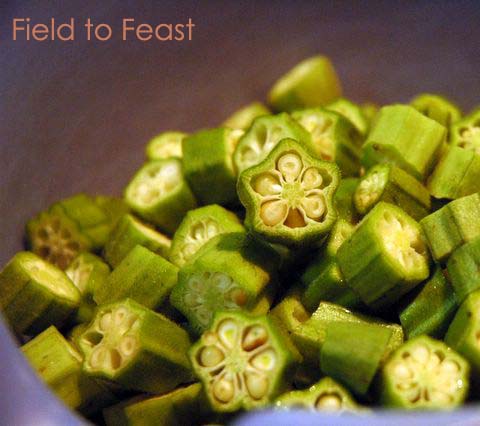
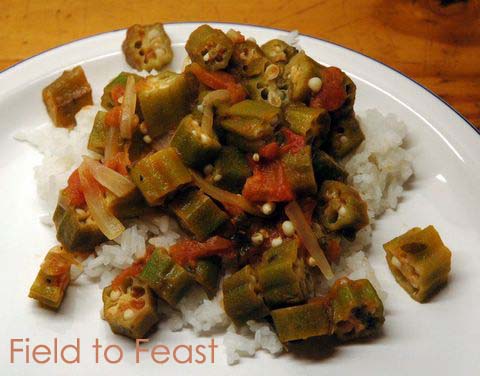
Okra is an African vegetable, through and through. It originated in present-day Ethiopia, and the word “okra” comes from Ibo, a language spoken in Nigeria. African dishes from the Cape to Cairo employ this long, tapered, hexagonal vegetable, including the two I tried tonight – okra with coconut (a recipe from the Indian community in South Africa) and bamia, an Egyptian okra stew.

I’ve tried okra fried. I’ve tried it in gumbo. I’ve tried it sautéed with tomatoes. And I have never once enjoyed it. But, to my amazement, I actually found these two dishes to be excellent – full of flavor and cooked so that the okra retains a bit of crunch, a technique which effectively distracts your attention from the vegetable’s slimier tendencies. Both okra recipes make excellent side dishes, and can be served over rice.

Okra with Coconut
Adapted from Mixed Masala: Indian Cookery South African Style
Serves 3-4 as a side dish

½ teaspoon coriander seeds
¼ teaspoon cumin seeds
2 tablespoons vegetable oil
½ teaspoon mustard seeds
250 grams/½ pound fresh okra, sliced into fine rings
1 tablespoon desi
ccated coconut
2 green chilies, cut lengthwise and then into halves
1 small onion, finely sliced
½ teaspoon salt

Put the coriander seeds and cumin seeds in a small fry pan over medium heat, and roast lightly. Grind the seeds into powder using a mortar and pestle, and set aside.

Pour the oil into a medium fry pan and set over medium heat. When the oil is hot, add the mustard seeds. Once the mustard seeds begin popping, add the okra. Sauté for 5 minutes, stirring frequently. Turn the heat down to low and add the freshly ground coriander and cumin seeds, desiccated coconut, chilies, onion and salt. Stir. Cover and cook for 10 minutes, or until the okra is tender. Lift the cover occasionally to give the mixture a stir. If the okra is sticking to the bottom of the fry pan, simply add a bit of water.

Egyptian Okra Stew (Bamia)
Adapted from Recipe Zaar
Serves 4-6 as a side dish

1 tablespoon olive oil
1 medium onion, cut in half and finely sliced
2 small garlic cloves, minced
1 400-gram/14-ounce can whole peeled tomatoes
Juice of one lemon
1 tablespoon fresh parsley, chopped
1 tablespoon cilantro (a.k.a. fresh coriander), chopped
½ teaspoon ground cardamom
Pinch of salt
¼ teaspoon freshly ground black pepper
700 grams/1½ pounds fresh okra, cut into ½-inch rounds

Heat the olive oil in a medium saucepan over medium heat. Add the onion and garlic, and sauté until the onion is translucent, about five minutes. Add the tomatoes (with their juice), lemon, parsley, cilantro, ground cardamom, salt and pepper, and stir, making sure to break up the tomatoes with the back of your spoon. Simmer for five minutes, stirring frequently. Add the okra and stir. Cook for another ten minutes, or until the okra is tender but not mushy. Serve hot.

One down, two to go. Now does anyone have a particularly enticing papaya preparation to share?

* I must offer the caveat that I don’t eat meat (pork, chicken, or beef). I don’t consider these to be items I don’t like, just foods I choose not to eat!