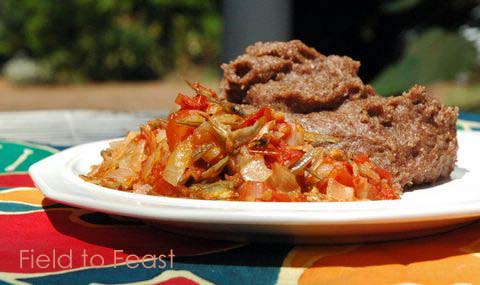
I ended my last post with a wish that the flicker of hope I saw in the days after the 29 March election would reignite. I was wrong, however, to assume the flame had disappeared. It remained a smolder low to the ground, tended by brave people, despite the boots and sticks and metal rods trying to snuff it out.
Yes, blogging about food still seems trivial to me. But, it also seems like something I need to do to take a mental break from thinking about the situation here. So, after two months, with this post, I am back! I’ll be consciously avoiding any discussion about the political or humanitarian situation here (which you can read about here, here and here), mostly for my own sanity. So today, I will tell you only one thing about Zimbabwe – a story about the country’s indigenous nyimo bean.
Nyimo bean is the local name for the Bambara groundnut, a legume considered an underutilized, “lost crop of Africa,” because it is little known outside of the continent. Even in Africa, the Bambara groundnut is often thought of as a “poor person’s” crop and is eclipsed in popularity by its botanical cousin, the peanut, who arrived 400 years ago from Brazil and is now an important source of nutrition in more than 30 African countries, including Zimbabwe. Interestingly, both Bambara groundnuts and peanuts were brought to North America from Africa during the slave trade – there are references to both beans in the diaries of the colonialists. But, once again, the peanut outshone its kin. I bet, though, if you live in the U.S. state of Georgia, you might just be able to find someone still growing the Bambara groundnut. Let me know if you do!
Despite being repeatedly overshadowed, the humble nyimo bean still has its staunch admirers – those who respect its nutritional might (this bean is 20 percent protein!), its ability to thrive under harsh conditions, and its addictively earthy flavor. Zimbabwe itself gave birth to “BamNet,” the International Bambara Groundnut Network, in 1995.
Here, Tulimara cans nyimo beans for sale in some supermarkets. These work well in soups, or for making “African” hummus. Near the end of the rainy season, you can buy dried nyimo beans by the side of the road in rural areas, or from the vendors who ply busy downtown intersections. They are easy to mistake for peanuts, which have the same brown, fibrous shell. The main difference is that the nyimo bean’s shell is rounder – it was not blessed with the peanut’s hourglass curves.
You can prepare dried nyimo beans in several ways. What I do is boil them in their shell in heavily salted water under tender (about 30-40 minutes), drain, salt again, and serve. A bowl of beans with a nice cold pilsner are a perfect game-time snack. Just don’t get too scared when you crack open the shell – boiled nyimos do eerily resemble eyeballs! Like peanuts, nyimo beans will absorb flavor through their shell while boiling, so you could add soy sauce and star anise to the water, for example, if you want more complex tastes.
Boiled nyimo beans can also be roasted. And, they can be pounded into flour, either after boiling or after both boiling and roasting. This flour can be stirred into maize meal porridge. I’ve read that in Nigeria, women use the flour to make pancakes.
Now, I realize most of you readers are a long way away from the nearest Bambara groundnut! What learning about this little legume made me think about, however, are the many fruits and vegetables in our midst that might have been shoved aside by history – maybe because they didn’t keep as well during transport, looked ugly canned, had a unappealing name, or got a reputation as second-class food. They all might be worth a second look.
Saturday, June 28, 2008
Back, with a Bean
Saturday, April 05, 2008
And on the Eighth Day…
We waited.
A week ago today, the citizens of Zimbabwe went to the polls. They emerged proudly displaying their pinkie fingers, stained pink from the ink used to mark their votes. Excited whispers of change wafted on the air like errant plastic bags, shreds of new information were panned like gold, and I saw – for the first time in my three years here – a flicker of hope on the faces of people in the street.
Now, a week has past. The ink has disappeared. And so has the flicker of hope. As the delay in the release of Presidential results continues and the political posturing takes a hard-line turn, a veil of resignation has again descended and I can almost tangibly feel people looking inside themselves, trying to determine how they are possibly going to dig a deeper well of patience.
What is going to happen?
The election has been on the front few pages of international newspapers this past week. At first, articles could follow a simple narrative – the possibility of a dramatic opposition party victory despite reports of vote-rigging, followed by mounting concern over delays in announcing the results, rising tensions, and the specter of Kenya-style violence. But, I fear, the story is no longer fitting the sound-bite style of the American press. It is dragging on too long, becoming too convoluted. How do you explain the point we are at today? STILL no Presidential results announced, when it is clear they must be known? The new possibility of a run-off in 90 days instead of the three weeks stated in electoral law? The ruling party accusing the opposition of bribing electoral officials; the opposition party going to court to demand that Presidential election results be released? We are used to craziness here (case in point: the Reserve Bank introduced a 50 million dollar note yesterday). But how do you continue to explain all this to someone outside the country?
Is there a strategy at play? Delaying, stalling, confounding until the short attention span of the West loses interest? And what will happen then, when fewer eyes are watching?
I’ve got three new posts half-written – one about a relative of the peanut native to Africa called the Bambara groundnut; another on a recipe for homemade graham crackers, culled from a circa-1980s African missionary cookbook; a third on Ethiopian-style cabbage and lentil salad. This all seems so silly. The posts will wait. For now, my mind is elsewhere, trapped in the maze of this saga’s twists and turns, and dreaming for that flicker of hope to reignite.
In addition to the coverage on BBC and Sky News, you can keep up-to-date on election news by checking these sites:
Sokwanele, and its related blog – This is Zimbabwe
Kubatana’s blog
SWRadio Africa
Monday, July 23, 2007
What a Contrast
 Some people think things through as they talk. You can see it happening. At first, their explanation or argument wanders here and there, and then, all of a sudden, they see the way forward. Their words gain momentum – sentences tumble out, the decibel-level increases – until suddenly everything is tied together and the meaning is clear. Such individuals can start talking with only a faint idea or glimmer of an opinion, and somehow end up with a cohesive, communicated thought.
If I attempt this feat, my words trail off into a sea of mumbles in the hope that no one notices I had begun speaking in the first place. Instead, when I want to express an idea or an opinion out loud, I need to think it out thoroughly beforehand; rarely by talking do I hit my stride.
 Today, I sat down to write about the idea of contrast. The nibble stems back to last December when, within a month, I visited two dramatically different places. First, I visited a rural area of
 Eastern Highlands of Zimbabwe – an actual castle, complete with dust and damp – perched on the side of a cliff overlooking the border with

Sunday, July 15, 2007
One Year, Happily Consumed
 A year ago, as I pressed “publish” on my first post, I remember worrying that I might run out of ideas. Was creating a food blog focused on
Today, Field to Feast turns one. And, instead of worrying that I might run out of ideas, I am slightly overwhelmed by them. My list of things to make and notes for stories to share is lengthy. I could write for years and years, and hopefully will.
 Meanwhile, some of the comments and e-mails I have read with the most pleasure have come from Zimbabweans, both in the country and overseas. There was the Zimbabwean man living in the U.K. who showed his British girlfriend my post on kapenta, former residents who’ve reminisced about sadza, and welcome support for my meagre efforts to use the subject of food to shed some light on the country’s complex political and economic situation. Thank you, all.
 Keeping this blog has introduced me to new people and made me more curious about the foods around me and how they are eaten. In the past year, eating along with Field to Feast, I have discovered dozens of new ingredients and recipes – many of which, like malva pudding, bobotie, Nigerian beans, peanut butter rice, Zanzibari coffee and rosella tea, have become part of my life. This year, I am planning at least a couple more "field trips" so that I can bring you additional on-the-ground perspectives on African food. I hope
 I’ll leave with you with a few of the new fruits and vegetables I’ve discovered over the past year - the photos are along the side. The first two are wild fruits most often eaten in the rural areas of
Wednesday, July 04, 2007
Supermarket Adventures, Zimbabwe Style
 Today the headlines about
Saturday, June 09, 2007
Helping Each Other: A Zimbabwean Feast
 The world has many holidays to be celebrated, many guests to be welcomed, many special occasions to be recognized and many accomplishments to honor. In other words, there are many good reasons to hold a feast. Last Saturday, the women of Batsiranai held a feast to an honor an accomplishment – their own.
I have been meaning to write about this amazing group of women for a long time. The members of Batsiranai are mothers of disabled children who live in a township on the outskirts of
 Such circumstances would overwhelm the best of us. But Batsiranai means “helping each other” in Shona, and helping each other is the core of what these women do. By helping each other, the Batsiranai mothers have established a successful craft-making enterprise that enables their families to thrive. They sew, paint and embroider many different items – tote bags, purses, bookmarks, baby quilts, baby bibs, bottle-cap earrings, greeting cards and more. Attached to the women’s workshop is a day care centre where their children can rest and play while they work. A nearby hospital has an outreach team which regularly visits the center to talk to parents about how to help their children grow and develop. Batsiranai has other “helpers,” too, including volunteers who’ve made the day care center a welcoming place through colorful painting and donations of toys; volunteers who’ve connected them to retail markets outside of
  Last Saturday, Batsiranai celebrated a major accomplishment – the completion of an order for thousands of dolls. It was a huge project, and, to complete it on time, Batsiranai trained mothers of disabled children from other townships in how to make the dolls. The Batsiranai spirit is spreading. At the feast, one of the new recruits said, “Thank you for giving us the opportunity to earn money; now we come home on Fridays with pay and our husbands have already done the ironing.”
 And what was the menu for this feast? Beef, beef and more beef, plus sadza, cole slaw and a tomato and onion relish. And, just as important as the food, the feast was preceded by hours and hours and hours of singing and dancing.
You might not be able to make it to Batsiranai’s next feast, but you can certainly honor these women’s accomplishments by buying their fair trade-certified products. Their products are of very high quality, and make excellent gifts! Simply visit www.batsiranai.co.zw.

 (Full disclosure: my husband has volunteered with this group for almost two years!)
Sunday, June 03, 2007
A Sprinkle a Day
 When my brother and I were growing up, the treatment of choice for asthma was a medicine called Theo-Dur. To tempt little asthmatics like us, Theo-Dur was packaged in sprinkle form. I can certainly understand the marketing ploy – why not subvert children’s inherent aversion to medicine and take advantage of their pure, innocent, instinctive love of sprinkles on ice cream? And, the doctor assured us, you could also sprinkle them on applesauce! And pudding! They will make every food more fun!
Well, they didn’t. My brother and I hated Theo-Dur sprinkles.
Theo-Dur sprinkles may have been the first thing in my life that I reluctantly consumed because it was good for me, but it certainly wasn’t the last. I try not to remember, for example, those tasteless celery-sticks I ate in high school because they were rumored to have “negative” calories. My present-day equivalent of Theo-Dur sprinkles is moringa. Moringa oleifera is a tree that grows in tropical and sub-tropical areas, and its leaves, fresh or dried, have many amazing properties. Three times the potassium of bananas! Four times the vitamin A of carrots! Four times the calcium in milk! It is for good reason that the tree is promoted here in Zimbabwe by organizations concerned about people’s nutrition, particularly the nutrition of people living with HIV and AIDS. Leaf powder can be added to any food! It adds flavor and nutrition! Sadly, however, one of moringa’s amazing properties is not tastiness.
Undeterred, my husband has been dusting dried moringa leaves onto his yogurt and muesli breakfast, and even his oats and brown sugar breakfast, for quite a while now. I tried it once, insisted it made my breakfast taste like grass, and thereafter turned up my nose at the stuff. Grassy might be a favorable description when discussing a chardonnay, but not my morning muesli.
I recently discovered that I’m a bit anemic, though, and now instead of just giving me a “but it’s SO good for you” look of guilt every morning as I snub the moringa, Mark has become quite pushy. You see, one of moringa’s amazing qualities is that it is a good sourse of iron. Sigh. Rather than face grassy muesli every morning, however, I decided needed to find a better conduit for the healthy green stuff. Today, I had a breakthrough.
Zimbabwe’s electricity situation is bad and getting worse, and this afternoon we only had power in half of our house (strange, but true). This meant I had a functioning oven, but a non-functional stovetop. I never realized how many baked meals actually require a little sauté action beforehand. It is really quite a few. I finally settled on preparing a tapas-like lunch of brushcetta, feta-stuffed peppadews, roasted broccoli (tossed with dried red chili, lemon juice, olive oil, salt and pepper) and roasted green beans (tossed with salt). In an effort to add a little more zip to the roasted veggies, I prepared a yogurt-based dressing, and, in a burst of inspiration, added a healthy dose of the dreaded moringa. Its grass flavor blended right in, and the dried leaves accentuated the dressing's mellow green hue. I’ll add a sprinkle any time.
African Green Goddess Dressing
Plain Greek yogurt
Avocado
Parsley, chopped
Scallion, sliced
Dried moringa leaves (optional)
Lemon juice
Salt
Pepper
The amounts here are quite flexible – do what tastes good to you! Blend everything together using an immersion blender or food processor. Serve as a dressing or dip for roasted vegetables.
Sunday, March 11, 2007
The Dairy
 “Right near your house there is a Greek woman who makes haloumi. Just round that corner and look for the black gate. Tell her I sent you.”
“The wife of my Japanese mechanic sells the tofu she makes at home – let me know if you want to buy a block.”

 And so Mark and I became acquainted with what we now simply call “The Dairy.” The Dairy is run by an unintentionally charismatic mother-and-son team (let’s call them Shirley and Frank), and the reason it is open for only two hours a day is that these are the hours when the cows are milked. The milk travels from udder to pail to your container. It is still warm. And rich. And creamy. Like a concentrated version of store-bought milk.
Speaking of The Dairy’s  wheel, you also must demonstrate respect and love for cheese. Frank tells the story of a woman who wanted to buy two wheels of
A few months ago, we heard The Dairy might be taken over as a result of the government’s ongoing land reform program. I can’t say we were shocked, but we were immensely saddened – sad for the family, the farm workers, the animals, and, quite selfishly, ourselves. No more calming walk past the animal stalls with the farm dogs scrambling around our feet. No more debates over goo-da and gow-da. And the thought of having to buy the soggy, chewy, greasy supermarket products that pass as “cheese” was just unbearable. Luckily, The Dairy survived. We appreciate it even more.

Wednesday, January 31, 2007
Beer Brewin’
 I once read that the arrival of tea on
With a lot of help from our housekeeper, Dorothy, this weekend we brewed chikokiyana, or one-day beer. I’m not going to write up a proper recipe (really, who among you is going to try this?), but here, for your reference, is the basic idea.
 First you bring about eight cups of water to a boil. Meanwhile, in a small bowl, you mix together four wooden spoonfuls of mealie meal (the finely ground cornmeal used to make sadza) with some water to make a thin gruel. Stir, breaking up any lumps, and then pour the paste into the boiling water. Stir again, partially cover, turn the heat down to medium-high, and keep the pot at a low boil for 15 minutes.
 Twenty-four hours later, remove the cover and watch the beer’s effervescent bubbles sputter and pop. Give the brew a stir, and then drink it straight from the pfuku. Or, if you are me, pour yourself a small glass. Chikokiyana is gritty, sour and yeasty – in other words, an extremely acquired taste. I could only get down about three sips; my husband four. Dorothy’s cousin downed the rest during the course of one day.
Wednesday, November 08, 2006
A Tag, a Picnic, and a New Warm Salad
 Maintaining a food blog isn’t all fun and games you know. Sometimes you get witheringly challenging assignments from your peers, like the one I recently received from lobstersquad. Stop by and admire Ximena’s endearingly carefree writing and illustrations, and then note that she has “tagged” me to respond to the following question: “Which menu would you serve food-blogging friends for a welcome dinner upon their first visit to your home?” This meme was started by Angelika of The Flying Apple, and has solicited numerous mouth-watering replies.
Well, my food blog friends, you’ve come a long, long way to arrive here at my home in
However, what you really want to know is – what will you be eating? Well, the assignment asks for “signature” dishes, and one of my entertaining signatures is dips. I love dips. In fact, this may sound like one tall tale, but I once shared my recipe for feta-walnut dip (a recipe adapted from Molly Katzen’s Moosewood Cookbook) with a friend in North Carolina, who happened to be friends with the then-boyfriend of Rachel Ray, who loved the dip, made her own modifications, and prepared it on Oprah earlier this year. True story.
In addition to my feta-walnut dip, you’ll be munching on spicy hummus, beetroot pesto and olive tapenade, all waiting to be scooped up by toasted pita crisps. Other nibbles will include baked ricotta cheese and boursin-stuffed peppadews. You’ll wash these appetizers down with cool sips of rooibos sangria, straight from my trusty cooler.
Next up will be a creamy avocado gazpacho, followed by a warm green salad with spicy peanut-butter dressing and sadza-sage croutons. This is a special recipe I invested just for you. I know you’ll want to try some Zimbabwean food during your visit, but, to be honest, the local cuisine doesn’t really lend itself to picnics, multi-course meals or chardonnay-laced toasts. My salad adds some new flavors to a traditional Zimbabwean relish made with greens, tomato, onion and peanut butter and transforms its traditional sadza accompaniment into tasty croutons. You’ll find the recipe below (with an option to use polenta instead of sadza for the croutons) just in case you can’t make my picnic. The main course – a light one, since we have a bit of a hike back to the car – will be Savory Broccoli and Cheddar Strudel, garnished with a dollop of chakalaka.
 The wine selection in
Finally, I have bad – and long-standing – habit of trying out new recipes on unsuspecting guests. It is not surprising, therefore, that I have found the perfect untried and untested dessert for you all. I recently discovered a recipe in Food and Home Entertaining (September 2006) for a grilled fruit platter that looks simply stunning – grilled chunks of pineapple, cantaloupe, bananas, strawberries and guava in a mango reduction sauce topped with toasted fresh coconut. This dish is supposed to be served at room temperature, which makes it a perfect take-along picnic treat. Just in case this plan backfires, however, I’ll have some sweet baked nuts on hand.
Sleepy, full, and sun-kissed, we will lethargically make our way back to my house, drink some tea or coffee on the veranda, watch the sun set, and reminisce about that lovely warm salad.

Warm Green Salad with Spicy Peanut-Butter Dressing and Sadza-Sage Croutons
Serves 2 as a side salad
Adapted from a traditional Zimbabwean relish and a crouton recipe in Food and Home Entertaining, July 2006
1 cup sadza
1 tablespoon butter
2 sage leaves, minced
1 teaspoon olive oil
Salad
1 tablespoon olive oil
1 dried red chili pepper, crushed
½ an onion, finely sliced
1 large bunch of greens, chopped (I used a medium bunch of Swiss chard, supplemented by a handful of beet greens)
1 medium tomato, chopped
1 small clove garlic, minced
Salt, to taste
2 tablespoons natural peanut butter
1 teaspoon hot water
Juice of ½ a lemon
To prepare the sadza croutons, first you need some sadza, which you could create by making this recipe. For those of you far from sadza, you can use polenta. Stir in the butter and sage during the last five minutes of cooking either the sadza or the polenta. Let the sadza or polenta cool slightly, then use the back of a wooden spoon to flatten the sadza/polenta into a square, 3/4-inch tall pancake. Cut the sadza/polenta into cubes and grill using a hot griddle pan and the olive oil. You’ll end up with a few more croutons than you’ll need for this salad, but you can store them in an airtight container for future salad-topping use over the next few days.
Tuesday, October 10, 2006
Road Trip, Snack Trip
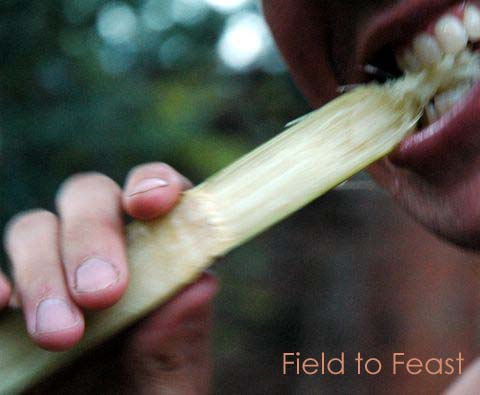 Road trips are 30 percent about getting to a destination, 30 percent about the journey, and 40 percent – heck, let’s forget math and make it 50 percent – about the food you eat along the way. In my years of roadtripping with friends and family, I’ve found that there are a variety of road-trip eating strategies.
I speak of road trips because this past weekend Mark, a friend and I drove six hours southeast of 
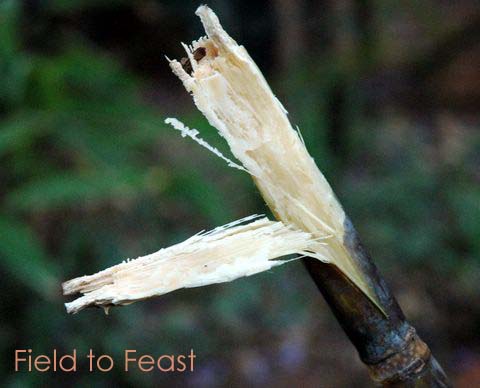 chewing it, and sucking out all the sweet juice. Then, in a move that is hard to accomplish gracefully, you must spit out the well-masticated pulp and throw it out the window. My husband does all this much better than me, which is why he is in the photo. Sugar cane fills many road trip snacking needs, as it provides a quick sugar burst and the chewing keeps your jaw busy for a while. And, if you ask the nice woman who sells you the sugar cane to break it into smaller pieces, you won’t even make much of a mess in your car.
Our road trip didn’t give us the option of junk food, exits or a variety of roadside eating establishments. It did however, give us sugar cane. Which means that, all in all, sugar cane helped make our road trip what it should be – a snack trip.
The top photo in this post was named "Best in Originality" in the October 2006 edition of "Does My Blog Look Good in This," a food blog event hosted by Spittoon Extra.
Saturday, September 30, 2006
Muddy Sadza, Smelly Fish
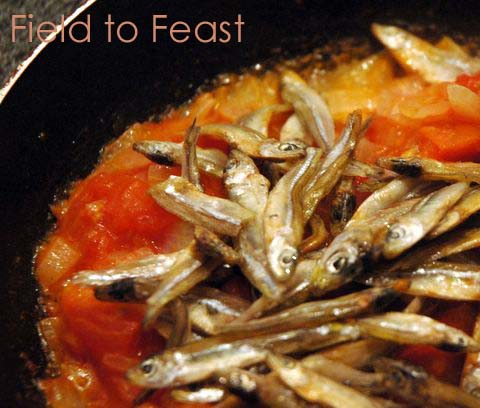 Last Saturday, Mark, Dorothy and I had a memorable visit to Mbare Musika. This Saturday, Dorothy and I began cooking with our market bounty. Today’s lunch? Sadza rauzviyo, served with kapenta relish. Before we get to these recipes, a here’s little background on sadza, kapenta and relish.
Serves 2-3
1 teaspoon vegetable oil
1 small onion, chopped
2 small tomatoes, chopped
Pinch of salt
Serves 2-3
2 cups zviyo (a.k.a. rapoko)
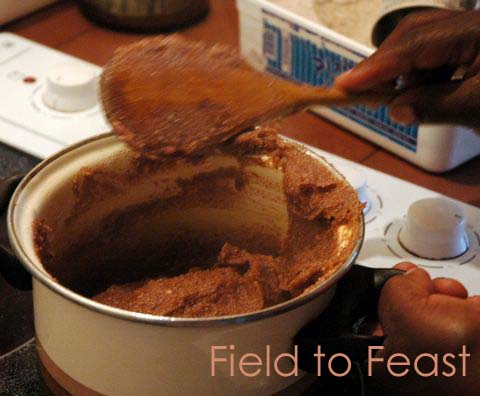 Bring the water to a boil in a medium saucepan. Turn heat down to medium-high and sprinkle ¾ cup of the meal (a big wooden-spoonful) over the top of the boiling water. Stir briskly, pressing the wooden spoon against the side of the pot to remove any lumps. Keep stirring for about five minutes.
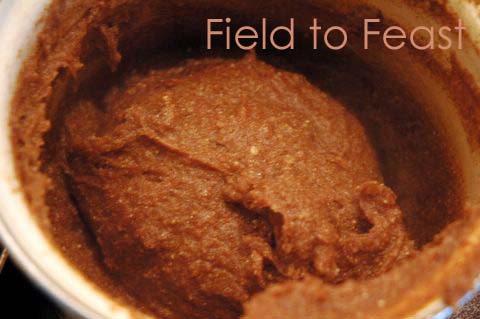 When the mixture is smooth and is beginning to puff and bubble like lava (or, to my eye, the hot mud pools in Rotorua), stop stirring and keep a safe distance from the pot so you will not get hit by a lava burst. After 10 minutes, add another ½ cup of the meal and stir, stir, stir. Once it has been absorbed, add another ½ cup of meal. Stir, stir, stir. Add the remaining ¼ cup, and stir again. The sadza should be thick and smooth, and your arm will be tired. Spoon the sadza onto a plate and let it cool for a few minutes.