Showing posts with label Travel. Show all posts

Monday, September 01, 2008

A Field Trip to Cambodia

Serve me fresh fish, and I am a happy girl. Serve me fresh fish topped with crispy, stir-friend threads of ginger, squid sautéed with green peppercorns, banana flower salad, and coconut milk and lime smoothies, and, well, I might never leave your country.

I did leave Cambodia, after one week of work, and one week of holiday. But it was hard.

Phnom Penh and Siem Reap - the two cities we visited - are bustling. Motos (motorbikes) and tuk-tuks (motos that pull four-seater, covered carriages) zip about, with scarce regard to traffic rules, traffic lights, or pedestrians' toes. Although
trials of Khmer Rouge leaders are ongoing, the Cambodians I met were focused more on the future than their country's past. Property prices are skyrocketing; tourism is beginning to flourish. And, of particular importance to me and you - good food is everywhere. Every third storefront seems to be a family restaurant. These home-restaurants often lack English menus - you'll just need to be brave, visit one that is crowded, and order by pointing at what someone else is eating. At night, when the restaurants close, family members fold up the chairs and tables and use the space as both their garage and living room, faces lit by the blue glow of the TV.

The local markets are crowded and chaotic, with motos struggling to weave amongst the people and the ground muddy from rain. Squatting women scale and chop fish using a cleaver and a short, circular butcher block. Enormous fish display their guts; slippery black fish squirm around in baskets; skinned frogs attract flies; marinated baby chickens turn on spits. Fruit stalls showcase homely-looking longan, flashy rambutan, the imposing durian, cutely dimpled lychees, smooth-skinned green oranges, and the miraculous mangosteen, which tastes like a concentration of every fruit in one bite.


Bicycles and motos trundle street food throughout town - Vietnamese spring rolls; French bread spread with fish paste; tiny snails, boiled and tossed with chili, salt and garlic (very tasty!); stir-friend noodles; sugar cane juice; and thin pancakes brushed with egg and dusted with Milo.

In Siem Reap, the home of Angkor Wat, "bouquets" of matte-green lotus flowers are sold by the side of the road. Like, in my opinion, the world's best snacks, lotus flowers take a bit of effort to eat - their edible seeds need to be individually popped out of the flower. These seeds have the texture of slightly under-boiled peanuts and a fresh, lightly-sweet taste reminiscent of edamame. They can also be boiled and roasted. Lotus roots are consumed, too - they add a distinctive crunch to salads.

On the road to Banteay Srei, one of the many temple complexes, almost every front yard boasts a little stand/shop/kiosk selling something - usually fabric, handbags, Johnnie Walker Black bottles filled with gasoline, and neat pyramids of boxes made from palm tree leaves and filled with discs of palm sugar. Women tend the stalls while simultaneously watching over a large, wide pot of boiling palm fruit, concocting palm sugar. Some stands also sell palm fruit fresh from the nut - it is squishy and opaque (like a jelly-fish, really) and the size of an egg, with a lychee-like texture, but a disappointingly bland taste.

We toured the Psar Salam (Big Market) in Siem Reap, a bit outside the main part of town, as part of a "Cooks in Tuk-Tuks" cooking class offer by the gorgeous
River Garden Hotel. I must have asked the chef who accompanied us 150 questions about the mystery foods on display. Cambodia has an amazing variety of eggplants - cream-colored, baby eggplants the size of blueberries (bitter-tasting, they eaten boiled or fresh with fish paste), green and white globe eggplants (grilled and eaten with pork), "bird" eggplants the shape and size of - you guessed it - bird's eggs. We saw caraway leaves, which grow amidst rice fields (they smell just like the seeds), green tomatoes and tamarind flour (used for making sour soup), hot basil and saw mint, cultivated and wild morning glory (also called water spinach), and tiembi (I'm unsure of spelling), which resembles a potato, but can be eaten fresh and tastes like a cross between a potato and an apple.

Yellow curry paste, sold from shallow plastic bowls, is made from kaffir lime, lemongrass, galangal, turmeric, and garlic, all pounded together. Pickled beans and radishes can be bought in scoops from glass jars, and are used to top morning porridge. Shredded, dried fish is another porridge mix-in - it tastes strangely sweet, like fishy cotton candy. A woman with a pole over her shoulder, hung with two baskets, sold us a fried rice flour cake, powdered in sugar; from another vender we bought a dessert of boiled coconut milk and sticky rice flour, served wrapped in a banana leaf and topped with shredded coconut.

If markets aren't your style, there is a fantastic array of restaurants to choose from. In Phnom Penh, one of our favorites was Romdeng, a new restaurant set in a beautifully-restored colonial house garlanded with a green-and-white-striped awning, feeds both your social conscience and your stomach. Romdeng is a project of
Friends International, and serves as a training center for former street children. Its dishes are artfully presented, and include such stunners as green mango and smoked fish salad with sun-dried shrimps, fresh river fish with green tamarind and a salsa of green mango and red onion, lime-marinated Mekong fish salad with galangal and saw mint, and red sticky rice porridge with coconut milk and longan. This is also the place to try crispy tarantulas - a Cambodian delicacy - here served with lime and black pepper dip. Nyemo, a restaurant run by an organization that supports women who have been abused, abandoned, trafficked or affected by HIV, serves a fantastic fish amok - one of the most well-known Cambodian dishes. Tender cubes of fish are steamed in a lemony, spicy coconut sauce, and served in a banana leaf basket. Don't go to Nyemo in a rush, however - service is slow!

Another yummy choice is Boat Noodle - the one at 8B Street 294 is located in a fantastic old wooden house. The dishes are served in narrow, ceramic "boats", with spicy sauces in the fore and aft. We made two trips to Sakrawa Café restaurant (#12 Street 118, near riverfront), where all the dishes 2.5-6 dollars. Its squid dishes are excellent - try the squid in black pepper sauce, served with julienned green pepper and red chili. Just beware of the bad lite jazz pumping through the loudspeakers.... If you need to duck in from the afternoon rain, like we did, the Tamarind on 31 Street 240 offers half-price drinks from 3-7 and excellent Mediterranean-inspired tapas. We enjoyed two Moroccan dishes –
zalouk and chakchouka (without the egg).

It would be impossible to mention Cambodian food without talking about prahok - the ubiquitous fish paste. Different varieties of prahok accompany meat, chicken or fish dishes; they can also be used as dips or stirred into soups. By outsiders, prahok is almost universally described as an acquired taste - I echo these sentiments! My husband, who is the only person outside of Australia and the U.K. who actually likes Vegemite and Marmite, was a quick fan, however - prahok shares the same concentrated, powerful, salty, fermented flavor of these spreads.

In case you are feeling particularly daring one day, here is a recipe for prahok from the cooking school at The River Garden. The chef said this version of prahok is most commonly eaten with chicken dishes. We ate it as a dip for veggie crudités - long green beans, cucumber and baby eggplant.

Don't forget the red ants! And don't let the prospect of eating prahok scare you off from a visit to Cambodia....


Cambodian Prahok
1½ tbsp fermented fish, chopped
3 cloves garlic, chopped
3 slices galangal
Small handful lemongrass, chopped
1 small red chili
1 tablespoon red ants (or the juice of 1 lime)
1 tablespoon liquid palm sugar

Chop together all ingredients until it forms a smooth paste.

More photos!


Banana flower salad at The River Garden


And maybe a few fried cockroaches?

Prahok for sale

To market, to market

Monday, August 20, 2007

Coma Peixes! A Field Trip to Mozambique

Seven hours may seem like a long time to drive for a meal of fish and chips. But when you live in a land-locked country and you know that, at the end of the road, the fish will be fresh from the sea, the chips will be thick and crisp, and the flames of piri-piri sauce will leave an addictive, lingering tang – well then, seven hours is nothing at all. This is the thought that passed through my head as I chased a garlic-y crumbed prawn, judiciously dipped in piri-piri, with a cold 2M beer on the first night Mark and I spent in Mozambique.

We were eating at a restaurant called Solange in bustling, 100-year-old Beira, a rough-around-the-edges port city located just where the country pinches in to its thinnest point. From our hotel room, we could see a small slice of the sea, wedged between two run-down concrete apartment buildings. The building to the left had a grey, concrete rooftop patio jutting out from its lower floors. At night, from 11-2, that innocuous patio emitted a throbbing, electrified African beat, to the great pleasure of an equally throbbing and electrified crowd. We had been told that Mozambicans like to party late into the night. Mozambicans did not let us down.

During our week-long holiday in Beira, Pemba, and Ibo Island, one impression stood out to me most: the sense that, although the country was once among the poorest in the world, and despite enduring scars from a 17-year civil war (1977-92), today Mozambique boasts an unremitting energy and optimism. We heard it in the animated chatter that rose above the blaring music on the rooftop patio. We saw it in the fresh paint on tiny roadside stores and newly-paved roads, in women’s clothes (vibrantly-pattered wrap skirts and dresses and, in urban areas, second-hand, neon tank-tops from Brazil), in the busy hubbub of curbside bike repair shops, in the mass of little kids playing in the ocean – splashing, somersaulting, and diving for joy – and in their older siblings, strolling back and forth along the beachfront, preening and posing for their peers.

You, as a visitor, need to capture this optimism, too, and put your faith in the fact that Things Will Work Out. Because although more and more tourists are traveling to Mozambique, there are few helpful signs or maps, limited transport options for getting from point A to point B, and tourist facilities full of smiling people who can’t really help you very much. Nevertheless, Things Will Work Out. To wit:

1) When it appears you will be stranded on the island of Ibo in the Quirimbas Archipelago of northern Mozambique, you will, at the last minute, secure seats on a tiny plane, befriend a Zimbabwean who drives one of the two vehicles on the island, and catch a ride to the grass-runway airport. This will be your view from 1000 feet:

2) When your 4x4 gets a flat tire and, seconds after you notice the spare is secured by a lock, you realize that, since you borrowed the vehicle from a friend, you don’t have the key…well, a friendly man will walk by who happens to be a mechanic. He will ingeniously remove the lock without the key.

3) When you are visiting the local street market in Pemba and – for the sake of this very blog – purchase some sweets from a snotty-nosed girl who, with one grubby hand, is waving away a swarm of flies, while, with the other grubby hand, passing you your selections…miraculously you will not get food poisoning.

4) When you spend the whole week trying to order a traditional Mozambican dish called matapa, only to hear repeatedly that, although the dish appears on the menu, it was not made today…on your last night in the country you will return to Solange and gleefully discover they offer a special weekend buffet that includes not one, but two types of matapa.

5) And, finally, when you fruitlessly search market after market for cassava leaves, the critical main ingredient in matapa, eventually realizing that cassava must be something everyone grows at home rather than buys…you will make one last market stop and meet a man willing to bike 15 minutes to cut cassava leaves from his own garden and bring them to you. Which he does.
Yes, Mozambique is the place for optimism.

It is also the place for excellent food influenced by African traditions, Portuguese cuisine (the Portuguese claimed Mozambique as a colony for more than two centuries), and the curry and coconut-inflicted Swahili cooking that Arab traders spread up and down Africa’s east coast. Knowing this was Opportunity ’07 to eat fresh seafood, Mark and I consumed frutos do mar at every meal – warm cod in a turmeric, coconut and parmesan cream sauce; cold cod served with a tomato curry (caril) sauce; smoked marlin; curried prawns speckled with dried mango; and garlic-drenched prawns (camarões), calamari (lulas), and fish (peixe), sometimes grilled (grelhado), sometimes fried (fritado), always with lashings of piri-piri.

I’ll feature four of Mozambique’s culinary revelations in subsequent posts: piri-piri sauce, matapa, cassava root (mandioca), and the sweets sold in street food stalls. The dishes I recreate in my home kitchen may not be as flavorful as the ones we ate in Beira, Pemba and Ibo. But, I’ll just have to be optimistic. Things Will Work Out.

A Summary of Food and Drink “To dos”
Beira, Pemba, and Ibo Island, Mozambique

In Beira:
Eat at Solange. There is amazingly varied buffet on Friday and Saturday nights for about US$12/person and a unique green piri-piri every night. (Thanks, Emily, for the tip!)

In Pemba:
- Watch the sunset from Aquila Romana, an Italian restaurant on the far end of Wimbi Beach, past where the paved road ends and the sand road begins. Your table could be the one in the opening photo, and your view will look like this:

- Visit the nearby JPS for Mozambican and Portuguese cuisine (matapa some nights).
- Watch the kids frolic in the ocean as you eat fish and batatas fritas on the deck of Pemba Dolphin on Wimbi Beach.
- Be greeted with calls of “Salama” (“Hello”) as you explore the vegetable market in town; you can answer “Salama” in return.
- Buy some better-than-Maldon sea salt from a vendor, and check out the stalls with dried fish of all shapes and sizes, chilies, onions, tomatoes, cabbage garlic, rice and flour.

On Ibo:
- Visit the newly-opened Cinco Portas, run by the extremely helpful and accommodating Isabelle, which offers quaint, basic rooms and serves excellent Portuguese and Mozambican food, with a strong Swahili influence, from a vibrant, open-air kitchen. If you aren’t staying there, arrange your meals with Isabella in advance so that she can make sure her team of local cooks prepares enough food.
- Watch the sunset from the courtyard at Cinco Portas while enjoying one of the local beer brands: 2M or Laurentina. The luscious, chocolaty dark version of Laurentina, Laurentina Preta, is highly recommended.
- Try a homestay with a local family – a new community tourism initiative on the island. You can arrange for your hosts to cook you lunch and dinner, and will always receive some sort of light breakfast – like these fried UFO-shaped treats made with rice, coconut and, I believe, a bit of lemon zest. Contact Ibraimo Assane at +258 825511919.
- For a splurge, stay at Ibo Island Lodge, a beautifully restored house with fantastic architecture, a great view, and fabulous staff. We didn’t stay here, but wish we could have!

If you are in interested in traveling to northern Mozambique (both Pemba and Ibo are in the north), a good resource is Kaskazini.

Many thanks to Mariana (our traveling companion to and from Beira) for her insights into Mozambican food, and her translation assistance!

Gratuitous extra photos!

A day’s catch – Pemba

The old market – Pemba

Downtown Pemba – a Goat Town

Baobab trees line the shore of Pemba Bay

Bananas, anyone? – A truck on the road to Beira

Shells, with tiny, edible snails inside, drying in the sun – Ibo

Check out my previous “field trips” here:
Rome
Zanzibar

Sunday, December 03, 2006

Karibu! A Field Trip to Zanzibar

If you are gorging yourself on coconuts, fish, pineapples and a bonanza of bananas, chances are, you’re on a tropical island. But if your fish is marinated in tamarind and lime, your tea steeped in lemongrass, your coffee infused with ginger and cardamom, your mouth burning from chilies, and your meal accompanied by chapattis and roasted breadfruit or cassava, then there is only one place in the world you could be – Zanzibar.

Like Timbuktu or Transylvania, Zanzibar is a place you might have heard of, but might not be able to state, with absolute certainty: 1) whether it truly exists or 2) where in the world it might be. Dust off your atlas and find Tanzania, in East Africa. Pick out Dar es Salaam, the country’s largest city, located along the coast. Off the coast, to the northeast, is the Zanzibar Archipelago. The archipelago consists of Pemba, a scattering of tiny islets, and the main island, Unguja (which, by itself, is often referred to as “Zanzibar”).

Zanzibar was a key trading post for slaves and then spices during the 18th and 19th centuries. This history created a society characterized by an amazing convergence of African, Indian, Arab and Persian cultures, all of which have influenced Zanzibar’s religion, architecture, and, of course, its food. For example, on Zanzibar you can eat ugali (Tanzania’s permutation of African stiff maize-meal porridge); dig into Indian-inspired plates of biriani, pilau and coconut milk-based curries; and nibble plump dates with your coffee. One of our trip highlights was snacking on lentil bhajias while watching the sun set over Stone Town from the Tower Top Restaurant at 236 Hurumzi (formally Emerson and Green), while the evening call for prayer wafted on the sea breeze from every mosque spire.

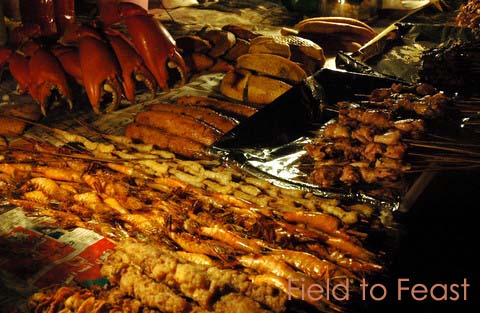
Coming from a landlocked country, we eagerly anticipated Zanzibar’s many opportunities for ocean-gathered eating. Upon arrival, we headed straight for Forodhani Gardens, a night market that boasts table after table laden with calamari steaks, octopus, crab claws and an astonishing array of fish kebabs – your choices include red snapper, kingfish, tuna, and prawns, to name a few. It’s a chaotic scene. Smoke rises from dozens of grills and every vendor uses his best sales pitch to attract your attention (and money) while you negotiate aisles clogged with wide-eyed tourists, gaggles of local teens, and “helpers” directing you to their preferred stall. Another Forodhani staple is Zanzibar pizza which, despite being a crêpe topped with cheese, green chili, onion, tomato, egg, cilantro, mayonnaise, ginger paste, garlic and minced meat (optional), somehow actually does taste like pizza and is surprisingly good. It also reminded me of a favorite street food from China, jian bing.

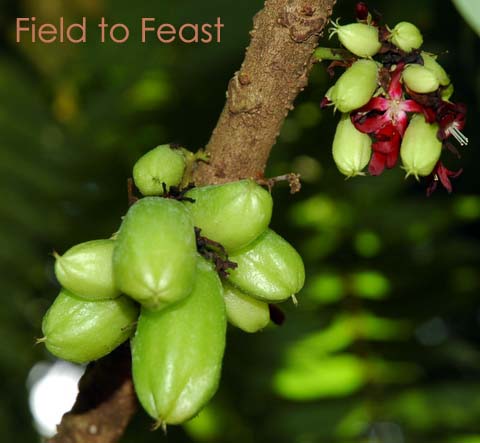
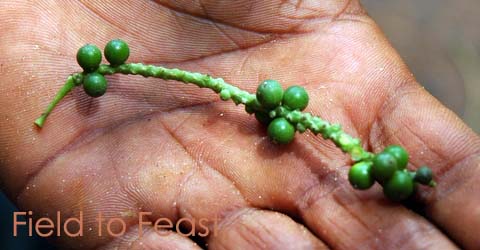
Zanzibar was once known as the Spice Islands, and spices are still an important export. “Spice tours” – visits to farms that grow spice-generating trees and plants, as well as tropical fruits – are an established tourist must-do, and we happily complied. We discovered that both cardamom and peppercorn are native to the island, but that the other spices Zanzibar is known for – vanilla, clove and cinnamon – were all brought here by the Omari Sultons who ruled during the 1800s, when Zanzibar was the Arab Empire’s capital in East Africa. I love learning where the ingredients I cook with actually come from, so it was fascinating to see turmeric and cardamom plants, vanilla-bean vines, and cloves growing on trees as well as drying on large sheets in the sun. We got to taste-test many items, including fresh peppercorns, straight from the vine (which make your mouth tingle) and the tart mbiri mbiri, a variety of star fruit used in recipes as a substitute for lime. We also timidly tried a red chili that is called “pilipili-hoho” in Swahili because you have to exhale with a “hoho” after eating it in an attempt to extinguish the fire in your mouth. In addition to being used in food, we learned that Zanzibaris have found other uses for spice plants and trees. For instance, cloves are used for toothaches and the menthol-scented root of the cinnamon tree is mixed with oil and used to relieve chest colds.

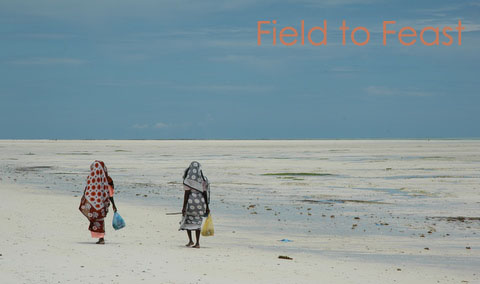
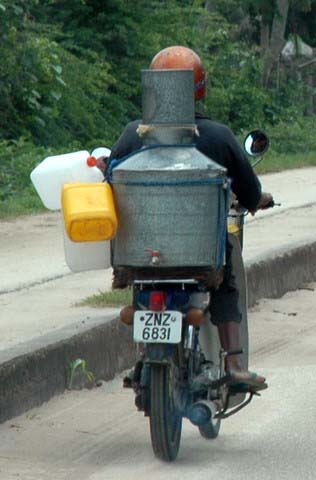
One of the many things I loved about Zanzibar is that although you can plunk yourself down on a stunning white-sand, palm-fringed beach, the island is not one big, sterile, tropical resort. It is very much a living, breathing, bustling and, in many areas, poor and gritty, place. Public transport consists of dalla-dallas – pick-ups with modified truck beds featuring benches, wood or iron-lattice sides, and an awning top. They rattle along streets lined with tin-roofed market stalls selling everything from fish to fruit to phone cards. Scooters zip and weave, some with strapped-on metal jugs that dispense milk – Zanzibar’s version of the milkman. By the coast, you can spot sailboats called “dhows” in the distance. They are endlessly photogenic, but also functional – this is what fishermen use to catch all that fish at Forodhani. At low tide, people with buckets wade into the ocean, collecting seaweed in plastic bags for export to East Asia, while young boys catch tiny fish in the tide pools using worms tied to a string.

Over the next few months, I’ll be trying to replicate some of our favorite Zanzibari dishes and drinks: red kidney beans with coconut (maharagwe), lentil bhajias, dawa (a drink made with konyagi, a local gin), Zanzibar pizza, Zanzibar coffee and many more. Stay tuned!

Tuesday, October 31, 2006

Mangia! Mangia! A Field Trip to Rome

Coliseum? Check. St. Peter’s Basilica? Check. Sistine Chapel? Check. Roman Forum? Check. During our trip to Rome, Mark and I even, by sheer coincidence, found ourselves standing four feet from the Pope. Mamma mia!

The mental postcards I took away from Rome, however, are not only images of its ancient sites and famous residents, but of its everyday people and everyday food. We will remember Osteria Antichi Saporo da Leo for 1) bruschetta con fagioli (a crusty slice of bread adorned with creamy white beans and doused in a fruity olive oil), 2) schiaffoni alla ricotta forte pugliese (rough-cut pasta tubes tossed in a tomato sauce made with an uncommonly pungent ricotta cheese), 3) radicchio con provola affumicata alla griglia (mounds of grilled radicchio capped by disks of provolone cheese, all well-moistened by a lemon-pepper vinaigrette) and 4) Leo, the proprietor. Pleased that we had just concluded our second meal at his establishment, Leo pointed to our empty glasses of raisin-soaked grappa and proclaimed – hands gesturing from his heart – “Free-o.” “Grazie, grazie,” we happily replied. With a flourish, he grabbed our glasses and gave us a refill of this traditional after-dinner liqueur, also “free-o.” Grappling not-too-successfully with my double-dose of grappa, I practically burst into tears as we said arrivederchi.

Another proprietor, another day. At Antica Caciara Trasteverina, Roberto proudly shaved off a paper-thin slice of his pecorino Romano for me to sample. I closed my eyes as it dissolved on my tongue, not wanting to hurry the experience by chewing. We purchased a wedge and asked if we could take a photo of his store. He said yes, and began carefully arranging his wheels of cheese to show off their best sides. (He apologized for stepping into our picture. We wanted him there all along.)

In Rome, foodie heaven is a neighborhood gastronomia like Antica Caciara Trasteverina. Cured meats hang from hooks in the ceiling, hand-scrawled labels identify a huge variety of cheeses and salamis, and shelves labor under bowls of pesto and submerged buffalo mozzarella. The walls are lined with row upon row of Italian olive oils and Italian wines, some graced with the distinctive black rooster seal which means that the Chianti Classico you are holding actually comes from Chianti. Seduced by a sample at a gastronomia called Volpetti, we bought dried Calabrian figs and pecorino di Fossa, a cheese that is wrapped in a cloth sack, placed on a bed of burnt straw in an underground hole, covered with sand and pebbles, and aged for 100 days.

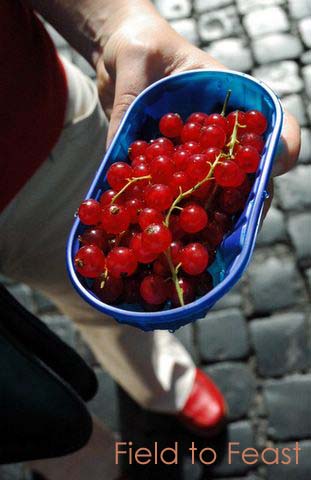
Overflowing fruit and veggie markets and sweet-smelling pasticcerias are also stellar spots for open-jawed food gazing and selective taste-testing. At Campo de’Fiori, stare-worthy vegetables included fresh borlotti beans in their mottled rose-colored shells, heads of cauliflower Romano with their eye-catching hue (chartreuse) and texture (imagine 3-D ice crystals), radicchio rosso di Treviso (a chicory variety that looks like white-flamed torches with burgundy tips), and tiny, unidentified berries, which glowed a luminescent red and tasted like cherry-infused strawberries. Meanwhile, the bountiful display cases at each pasticceria we visited made choosing an accompaniment to our espresso difficult – that is, until we discovered pinolate, a marzipan ball rolled in pine nuts, which we proceeded to seek out wherever we went.

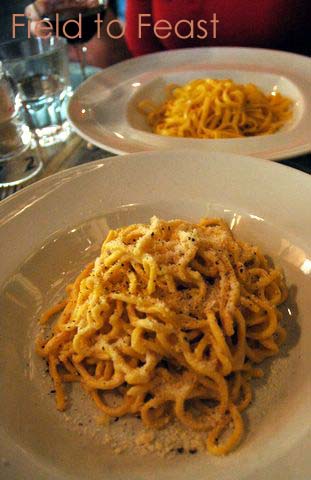
What amazed me most about food in Rome was first, how ingredients so simple could become dishes so extraordinary and second, why the heck I hadn’t heard of some of these dishes before. Take cacio e pepe, for example – pasta with a sauce made from Pecorino Romano, tons of ground black pepper, olive oil and, I suspect/fear, a healthy pour of cream. The pepper taste is quite powerful, and lingers in your mouth after every bite. At Alle Fratte di Trastevere the sauce was plentiful – almost like a peppery alfredo – and served with orecchiette, while at Antico Forno Roscioli it clung tightly to homemade spaghetti strands. A salad eaten on the piazza outside Osteria dell’Ingegno was notable for the phenomenal tenderness of its arugula, which was well-complimented by shaved parmesan, walnuts, halved cherry tomatoes, mushrooms and a light vinaigrette. The delicately battered and fried fresh anchovies (alici fritte) at Da Franco ar Vicoletto were juicy, meaty, and perfected by a squeeze of lemon juice. And the risotto of saffron and pistachios at Osteria Margutta was so rich that it was best eaten in tiny spoonfuls.

Can anyone talk of food in Italy without mentioning pizza and gelato? You cannot. The pizza in Rome is thin crust and comes in red (with sauce) and white (no sauce) varieties. Pizzaiole apply toppings with a light touch and do not disturb their masterpieces by slicing – you and you friends must admire their handiwork then tear off your own delectable, odd-shaped pieces. We particularly enjoyed one pie topped with tuna, capers and olives and another decorated with anchovies and curls of puntarelle, another type of chicory. After your pizza, the crème de la crème of gelato has to be the licorice version at San Crispino, which is served with a slather of dense whipped cream. Alternatively, you could try gelato’s cream-topped brethren, granita de caffe, which we found at Maestri Gelatieri di Calabria. This grated ice and coffee combo is perfect for when you want to experience your after-dinner coffee and dessert in one potent dose.

In a six-day trip, you can only eat and drink so much. Luckily, we brought some of Rome home – the aforementioned pecorino Romano, pecorino di Fossa, and dried figs, along with Arborio rice, polenta mix, a massive wedge of Parmesan, and a package of multi-colored estratterrestri, a shell-shaped pasta bought at a pasta-making stop called Pastificio that featured myriad pasta shapes, some stunningly striped like ribbon candy. But, despite our copious eating and load of take-home goodies, here, in no particular order, are foods I missed out on – otherwise known as reasons I must return to Rome:

Baccalà (salted cod)
Cavolo nero
(a black cabbage traditionally used to make ribollita)
Arancini and suppli (fried rice ball snacks)
Carciofo alla giudia (deep-fried artichoke)
Carciofo alla Romana (artichoke stuffed with mint or parsley and garlic)
Baba (a rum-soaked yeast bun)

Heading to Rome sometime soon? Lucky you! Listed below are the addresses of the shops and restaurants noted above. Mangia! Mangia! And beware of grappa refills.

Alle Fratte di Trastevere
Via delle Fratte di Trastevere 49/50, Trastevere

Antica Caciara Trasteverina
Via S. Francesco a Ripa 140, Trastevere

Antico Forno Roscioli
Via dei Giubbonaro 21-22, South of Campo de’Fiori

Da Franco ar Vicoletto
Via dei Falisci 2, San Lorenzo

Maestri Gelatieri di Calabria
Via Marmorata 111, Testaccio

Pastificio
Via della Croce 8

Osteria Antichi Saporo da Leo
Via Aurelia 366

Osteria dell’Ingegno
Piazza di Pietra 45

Osteria Margutta
Via Margutta 82

San Crispino
Via della Panetteria 42

Volpetti
Via Marmorata 47, Testaccio

Note: Many thanks to new mom Gia at Gia-Gina in Italy for all her eating tips!

Tuesday, October 10, 2006

Road Trip, Snack Trip

Road trips are 30 percent about getting to a destination, 30 percent about the journey, and 40 percent – heck, let’s forget math and make it 50 percent – about the food you eat along the way. In my years of roadtripping with friends and family, I’ve found that there are a variety of road-trip eating strategies.

First, there are the snack packers. Zip-lock bags and Lil’ Playmate coolers at their service, snack packers stow away all sorts of nibbles that successfully pass the no-crumb, no sticky fingers that need to be washed test. Especially worthy snacks include crackers sandwiched around peanut butter and raisins (our snack of choice on a recent trip), Goldfish and seedless grapes. I feel certain a South African would add biltong, just as a Montanan would add beef jerky.

Then there are the risk-takers. Like a water diviner sensing an underground spring, risk-takers use gut instinct and a tug of intuition on their arm (right arm in the States, left in the UK, Australia, Zimbabwe, etc.) to indicate which exit they should use to pull off the highway. The food available at the exit is unknown. The risk-taker does not care.

Meanwhile, the plan-aheaders pre-select and carefully mark on the map each scheduled eating establishment, all of which are conveniently located at hunger-pang-spaced intervals. A final category of road-trip eater includes the people who see road trips as excuses to eat junk food, and, licking their greasy fingers, happily take advantage of these plentiful opportunities.

Growing up, we utilized a strageic road-trip combination of snack preparation (after all, who wants to be in a car with two hungry kids?), observation of the plan-ahead advice offered by AAA travel guides, and close scrutiny of the blue “Gas, Food, Lodging” signs by the side of the road. If it was mealtime and one of these signs indicated that there may be a local joint at the upcoming exit, we would stop. Only local restaurants – that was the rule. Chain restaurants were not allowed on road trips because, as my mother said, travel was for experiencing new things.

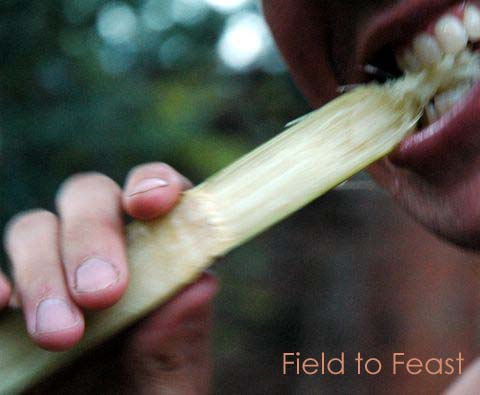
I speak of road trips because this past weekend Mark, a friend and I drove six hours southeast of Harare for a holiday in Gonarezhou National Park, which is situated along the border with Mozambique. Although we packed some snacks (macadamia nuts, peeled carrots, apples and cereal bars made with baobab pulp), we also knew we could acquire more treats along the way, since, no matter how rural the area, in Zimbabwe you can always find people selling fruits and veggies by the roadside. That’s how we ended up with this sugar cane.

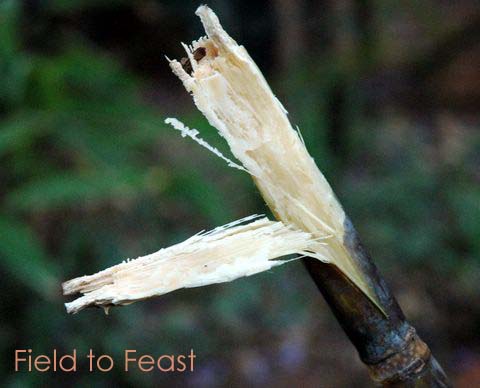
Sugar cane is, of course, used to make sugar. It can also be eaten fresh by peeling off the tough skin, tearing out the fibrous inside with your teeth, chewing it, and sucking out all the sweet juice. Then, in a move that is hard to accomplish gracefully, you must spit out the well-masticated pulp and throw it out the window. My husband does all this much better than me, which is why he is in the photo. Sugar cane fills many road trip snacking needs, as it provides a quick sugar burst and the chewing keeps your jaw busy for a while. And, if you ask the nice woman who sells you the sugar cane to break it into smaller pieces, you won’t even make much of a mess in your car.

Our road trip didn’t give us the option of junk food, exits or a variety of roadside eating establishments. It did however, give us sugar cane. Which means that, all in all, sugar cane helped make our road trip what it should be – a snack trip.

The top photo in this post was named "Best in Originality" in the October 2006 edition of "Does My Blog Look Good in This," a food blog event hosted by Spittoon Extra.