
 One expression you learn quickly in Zimbabwe – right up there among “shame” (said, while shaking one’s head, instead of “too bad”) and “howzit?” (“how are things?”) – is “make a plan.” Need to adapt to a new situation or create a Plan “D”? You are making a plan.
But “make a plan” is more than simply an expression; it is also a way of life in a country where every day brings change – new prices, new shortages, new government policies. Making a plan can be time-consuming and can test your patience. It can also force you to be creative and encourage you to try new things. Like millet.
Zimbabwe is primarily a cash economy, which meant that the cash shortage in December caused havoc. The low supply and high demand for cash drove down the exchange rate for cash, while prices at the store continued to rise. As a result, basic items became expensive (think: $10 for a package of spaghetti, $8 for a container of yogurt on the verge of spoiling). At the same time, there was very little cash around to make purchases. So, when I spotted a kilo of millet on the shelves for the equivalent of 50 cents, I snapped it up. I had never cooked with millet before, but thought this was as good a time as any to learn. Lacking pasta, dairy products, and flour, it was time to make a plan.
I toasted the millet grains in a bit of oil, and then set them to simmer in water. My family from Boston called in the midst of my preparations. “What are you cooking?” my brother asked. “Millet,” I said. “Isn’t that bird food?” I suddenly remembered the big bags of millet my dad kept in the garage to feed the birds. “Well, um, I guess so. We couldn’t buy much at the shops and I had to make a plan.”
Millet comes in different types, with different colors (yellow, reddish, and grey-brown, like the kind I bought). Birds like it, but so do humans. In Zimbabwe, millet grains are typically pounded to make flour, which is then cooked with water to make sadza. Instead, I used the cooked whole grains to make a salad. My husband brought the salad to work for lunch. His Zimbabwean co-workers looked at his meal skeptically and asked, only half-jokingly, “What, your wife doesn’t pound your millet for you?”
It might not be typical to eat whole millet in Zimbabwe, but I’d recommend it. The grains are nutty-tasting and a tad chewy, with a distinctive earthy aroma. A kilo goes a long way, so I’ve been trying out a number of different recipes. I prefer millet served at room temperature tossed with sautéed or roasted vegetables, a bit of crumbly soft cheese, and a splash of lemon juice or balsamic vinegar. When a recipe calls for bulgur, quinoa, or couscous, you can always prepare millet as a substitute.
Millet is very nutritious (a good source of fiber, B vitamins, protein, iron…) and is gluten-free.
The recipe below combines Madhur Jaffrey’s basic method of cooking millet with the vegetables and spices from a recipe in a South African cookbook called “Quiet Food.” In the “Quiet Food” recipe, the millet mixture is made into patties and used to create a vegetarian version of frikkadels (South African meatballs). I had trouble getting the patties to stick together, but liked the flavor of the mixture. So I made another plan, changing our meal from frikkadels to a well-textured, brightly-colored millet salad, with some fresh corn and fresh ricotta added in.
Next time you need to make a plan, make this millet!
Millet Salad with Carrot and Spinach
Serves 4-5
2 tablespoons / 30 milliliters olive oil, separated
1 cup / 200 grams millet (picked over, rinsed, drained and patted dry)
½ teaspoon / 2.5 milliliters dried oregano
½ teaspoon / 2.5 milliliters dried thyme
1 teaspoon / 5 milliliters salt
1 tablespoon / 15 grams butter
1 large onion, diced
2 medium carrots, diced or shredded
Kernels from a cob of fresh corn (optional)
2 cloves of garlic, crushed
1½ cups / 45 grams fresh spinach, chopped
¾ cup crumbled fresh ricotta (you could use feta)
Salt and freshly ground black pepper, to taste
Fresh thyme, for garnish
Have 2 cups / 500 milliliters of boiling water ready. Put 1 tablespoon / 15 milliliters of the oil in a medium saucepan and set over medium-high heat. When hot, add the millet. Fry, stirring frequently, for three minutes. Pour in the boiling water, cover, and set aside for 1 hour.
Uncover and add the oregano, thyme and salt. Stir. Bring to a boil, cover, and turn the heat down to low. Simmer gently for 40 minutes. Check to make sure the grains are now tender, but with some bite. (If not, cook until they are like this.) Turn off the heat and leave covered for 15 minutes. Almost all of the water should be absorbed. If not, you can drain it off.
Meanwhile, heat the remaining olive oil and the butter in a large skillet over medium heat. Add the onions, carrot and optional corn and sauté until they are soft, about 8 minutes. Add the garlic and cook for another 2 minutes. Add the spinach and cook until it has wilted. Remove from heat.
Combine the cooked millet, carrot mixture and cheese in a large bowl. Season with salt and pepper. Toss. Serve at room temperature, garnished with thyme.
Sunday, March 09, 2008
Make-a-Plan Millet
Sunday, February 24, 2008
Samp and Beans, Enlivened with Lime
 Corn has been getting a lot of publicity lately. But even before industrial agriculture dug its claws into this versatile cereal and invented high-fructose corn syrup, cultures around the world had devised myriad techniques for consuming every edible part of the plant. In Zimbabwe, you can buy roasted maize by the side of the road, or bags of popped maize, called maputi. Finely ground white maize (mealie-meal) is used to make the staple dish, sadza, as well as a thin porridge commonly eaten for breakfast. A Zimbabwean could easily eat corn three times a day.
Another corn permutation, common in southern Africa as well as the southern U.S. and Mexico – not to mention a food that kept the colonists alive in New England – is samp. Much has been written in an attempt to explain the difference between samp, hominy and grits, a task complicated by regional usages of these terms within the U.S. Here is how I distinguish between them:
- Hominy is dried, whole kernels of corn whose skins (or hulls) and germs (the little bit inside the kernel) have been removed.
- Samp is the same thing, except the kernels are cracked into a few pieces.
- Grits are ground hominy. Mealie-meal and polenta (typically made from yellow corn, instead of white) both differ from grits in that the hull and germ are not removed before grinding the dried kernels.
Got it?
Samp is typically paired with dried beans in southern Africa. In fact, you can often buy the soulmates packaged together in one bag. In South Africa, samp and beans (umngqusho) is a traditional dish of the Xhosa people, and was supposedly one of Nelson Mandela’s favorite meals growing up. You can serve cooked samp and beans with sautéed or fried onions, with butter, or with any sauce of your choosing.
This refreshing recipe employs lime, honey and mustard to create a light, punchy take on samp and beans that makes a refreshing side for shellfish or a lively addition to a summer salad buffet.
Honey-Lime Samp and Beans Salad
Adapted from Food and Home Entertaining, May 2005
Serves 4 as a side dish
1¼ cups / 200 grams samp (you can substitute hominy)
½ cup / 100 grams sugar beans (you can substitute pinto beans)
2 teaspoons / 10 milliliters salt
¼ cup / 60 milliliters olive oil
1 tablespoon / 15 milliliters whole-grain mustard
1 tablespoon / 15 milliliters honey
Zest of one lime
2 tablespoons / 30 milliliters fresh basil leaves, chopped
Salt and freshly ground black pepper, to taste
Fresh basil leaves, for garnish
Rinse the samp and beans and soak overnight. Drain, put in a medium saucepan, cover generously with water and add the salt. Bring to a boil, reduce heat, and simmer until tender, about 1½-2 hours. Drain and set aside.
Whisk together the olive oil, mustard, honey, lime zest and basil leaves and season to taste. Pour over the still-warm samp and beans and leave to cool. Serve at room temperature, or refrigerate and serve cool, garnished with the remaining basil leaves.
Saturday, February 02, 2008
Tiny Potatoes, Spicy Salad
 The number of vendors has increased over the past few months in Harare – shop-side vendors dangling plastic sleeves of tomatoes, potatoes, onions and okra from sticks like veggie mobiles; street-side vendors displaying their greens, mangoes, avocadoes and maputi (popped maize) on upturned boxes; and, my favorite, the men who defy death itself, standing smack dab in the middle of busy roads (even when the lights aren’t working) hawking the most delicate of commodities – crates of eggs.
Given Zimbabwe’s ever-more-astronomical currency denominations, bargaining for these items sounds absolutely ridiculous. “Tomatoes, imari?” I ask. “Five million.” “And the potatoes?” “Seven point five.” "I’ll give you 10 million for both." “11.” Sold. And so I count out a small pile of bills – one 5 million note and 30 200,000s.
I am picky about my produce. The tomatoes can’t be too ripe or too firm; the mangoes and avocados must be string-less. And the potatoes I seek out from venders are the tiny, spherical ones that you barely need to chop. A quick slice or two and they become bite-size.
These potatoes are ideal for tourchi batata, a spicy potato salad from Tunisia that can be served hot, cold or anywhere in between. This salad is quick to prepare and easy to double – after making it the first time and seeing my husband gobble it up I have vowed never to make a single recipe again. You could peel the potatoes, but I like to keep them on. I served tourchi batata last week as a tapas-like dish with afternoon drinks – beer cuts the spice best. I’ll let my friends make their own comments, but I think the salad was a hit.
Tunisian Potato Salad (Tourchi Batata)
Adapted from Sephardic Cooking: 600 Recipes Created in Exotic Sephardic Kitchens from Morocco to India
Serves 4 as a side dish
1 pound / 450 grams small boiling potatoes
2 tablespoons / 30 milliliters olive oil
1 teaspoon harissa (more, or less, to taste)
½ teaspoon / 2.5 milliliters salt
1 teaspoon / 5 milliliters ground cumin
1 lemon, freshly squeezed
Cook potatoes in boiling water for 15 minutes, or until tender. Cool and cut into cubes (or, with tiny potatoes, just in half). Heat the oil in a skillet, and add the harissa, salt, ground cumin and lemon juice. Bring to a boil and boil for a few seconds. Pour over the potatoes and toss. Let marinate for twenty minutes or so and serve warm, or serve at room temperature, or refrigerate for at least one hour and serve cool.
Sunday, December 02, 2007
Dear Salad
 Dear Salad,
It is a sunny Sunday afternoon here in Harare – a day just calling out for a salad – and I decided it was high time I write you a short note of appreciation. After all, I have enjoyed salads my whole life.
I’m not certain which came first – me liking salad or me liking the praise adults showered upon me whenever I ate raw vegetables. In any case, I started eating salad young. Growing up, my mom prepared a salad to accompany almost every dinner meal. To our great fortune, she saw right through the pale, watery leaves of iceberg lettuce and introduced us to romaine and red leaf and Boston lettuce way before the Jones’. We might not have had cable until 1995 or an answering machine until 2000, but we were eating tasty, nutritious salads.
My dad dressed you, salad, with his special vinaigrette. He has tried many times to show us how to accomplish this perfect balance of olive oil, red wine vinegar, salt, pepper and dried oregano, yet we can never make it quite the same. Whatever dressing remained at the bottom of the bowl was (and still is) carefully absorbed with a slice of Italian bread.
The other three salads I remember my mom serving were tomato salad (only made in August with tomatoes from our garden and, again, with my dad’s vinaigrette), chef’s salad, and ravioli salad – a “keeper” recipe my mom clipped from the newspaper that combines ravioli, fresh tomatoes, shredded zucchini and grated parmesan. I still make this salad today.
College might have expanded my brain, but it did not expand my repertoire of salads, even though I ate daily from the school’s salad bar. Since the cafeteria charged students according to the size of the salad bowl we used, I learned how to maximize the “small” bowl. I selected the sturdiest slices of cucumber and lined them up around the edges of the bowl, effectively adding another inch to the bowl’s height. Salad, I valued you, but I valued my precious “food points” more.
Once I began cooking on my own, I experimented with salads formed around bulgur and tofu, and learned to appreciate egg salad – now I not only like this Africa-inspired version, but also one by Mollie Katzen that mixes hard-boiled eggs with gremolata and ricotta. When my husband and I moved to Australia to study, we quickly adapted to ordering sandwiches “with salad.” As you know, in Oz, “with salad” does not translate to “side salad;” rather, it is the lettuce, tomato, and, oftentimes, beetroot, placed inside the sandwich itself.
Yet, it has really been over the last two years that I’ve discovered how diverse a genre you really are, salad. Since I began experimenting with North Africa cuisine, I’ve learned that by looking to Tunisia, Algeria and Moroccan, I can take any abundant fruit or veg from my fridge, garden or cupboard – carrots, zucchini, beetroot, dried peaches – and transform it into salads, both warm and cold. Now, I understand that anytime I am cutting up a vegetable and adding some sort of dressing – well, salad, there you are. Thank you.
Best wishes,
Carolyn
The salad I’m enjoying at the moment is a traditional grilled vegetable salad from Tunisia called mechouia (also written salata mishwiyya). It contains a cast of characters familiar to those who prepare chakchouka or turlu turlu. I’ve seen recipes that call for blending the vegetables together after they are grilled or crushing them with a mortar and pestle; others, like this one, request a good fine chop. In addition to the topping of hard-boiled egg and feta cheese, some recipes also call for tuna. Olives or capers would be welcome additions, too.
Mechouia (Grilled Vegetable Salad)
Adapted from Classic Vegetarian Cooking from the Middle East and North Africa
Serves 6 as a side salad
2 large red bell peppers
4 firm medium tomatoes
3 medium onions
1 small chili
45 milliliters / 3 tablespoons freshly-squeezed lemon juice
45 milliliters / 3 tablespoons olive oil
5 milliliters / 1 teaspoon oregano
5 milliliters / 1 teaspoon salt
2.5 milliliters / ½ teaspoon black pepper
2 hard boiled eggs, cut into wedges
40 grams / ¼ cup feta cheese, crumbled
Grill the red peppers, tomatoes, onions and chili (outdoors or on the stovetop), or broil in the oven. Turn the vegetables periodically. Remove the vegetables as they become soft – the chili will grill faster than the onion, for example.
Peel the skins from the peppers and chili and remove as many seeds from the chili as you want; you can keep a few in to add additional heat to the dish. Chop all the vegetables into small pieces.
In a large mixing bowl, whisk together lemon juice, olive oil, oregano, salt and pepper. Add the chopped vegetables and mix well. Transfer to a serving platter and scatter the egg and cheese around the top of the salad. Serve warm.
Sunday, July 29, 2007
One Veggie Star

Serves 4 as a salad
3¼ cups / 500 grams zucchini (a.k.a. courgette, baby marrow), very thinly sliced
1½ teaspoons / 7.5 milliliters ground cumin
2 teaspoons / 10 milliliters sweet paprika
Pinch of cayenne
¼ teaspoon / 1¼ milliliters salt
2 cloves of garlic, minced
1 tablespoons / 15 milliliters olive oil
2½ tablespoons / 37.5 milliliters fresh lemon juice
2 tablespoons / 30 milliliters vegetable broth (you can use water)
Handful minced fresh parsley, plus more for garnish
Sunday, February 18, 2007
The Lunch that Wasn’t a Leftover
 I don’t usually have post-worthy thoughts while heating my lunch in the workplace microwave, and some of you may argue that the thought I am about to share only barely qualifies as something of interest to anyone other than myself.
But, here it is: I don't eat lunch anymore.
Sure, I eat a meal between 1 and 2 in the afternoon. This meal, however, is always the remnants from dinner the night before, or the night before that (or, horror, even the night before that). I have stopped preparing food that is, truly and proudly, lunch.
Clearly, this is a major omission on my part, because the meals that characterize lunch – and only lunch – have some wonderful qualities. A whole genre of these meals comes wrapped within the warm arms of bread; another species – light, airy and gently moistened – gains its substance from lettuce. Lunch meals can also be purposefully dainty and, well – lunch-size – by appearing as individual servings of quiches, pizzas or savory tarts. Oh, what I have been missing. I could blame the lack of good sandwich bread in
Post-realization, however, I set out to change my ways and begin preparing proper lunch food. In my quest for a suitable rut-breaking recipe, I turned to The Soul of a New Cuisine. This cookbook by Marcus Samuelsson not only includes recipes for traditional African fare, but also for dishes that take African spices, ingredients and preparations and apply them to other cuisines. Thus, in Samuelsson’s able hands, boring old egg salad becomes piquant, ruddy-hued, peanut-studded egg salad, with nary a dollop of mayonnaise in sight. This is egg salad like you’ve never had it before, which, for me, is a good thing, because I’ve never been too fond of the egg-y aroma and squishy consistency of traditional egg salad. (In fact, as a child, I disliked the smell of egg salad to such an extent that when my parents told me they had almost named me Alison, I said, “I’m so glad you didn’t! ‘Alison’ sounds like ‘egg salad.’” ) Samuelsson’s egg salad may lack the pretty, lemon color of traditional egg salad, but the recipe more than compensates with its complex textures and spices.
Because it contains fresh tomatoes, this salad does not keep very well, and I suggest you make it on the day you plan to eat it. For easier workday morning preparation, you can prepare both the sautéed peanut and spice mixture and the dressing on the night before. Serve – for lunch, of course – on a wheat-bread sandwich, or cradled in a Romaine lettuce leaf.
Spiced Egg Salad
Adapted from The Soul of a New Cuisine
Serves 4-5 spread on a sandwich, 3-4 scooped onto lettuce
35 grams / ¼ cup dry-roasted and unsalted peanuts, blanched and de-skinned
1 green chili, seeds and ribs removed, minced
1 small red onion, minced
1 small scallion, finely sliced
3 garlic cloves, minced
15 milliliters / 1 tablespoon paprika
2.5 milliliters / ½ teaspoon ground ginger
7.5 milliliters / 1½ teaspoons chili powder
15 milliliters / 1 tablespoon soy sauce
Juice of 1 lemon
3.5 milliliters / ¾ teaspoon salt
5 hard-boiled eggs, peeled and chopped
2 ripe tomatoes, chopped
10 milliliters / 2 teaspoons fresh lemon thyme, or other fresh herb of your choice
Saturday, November 18, 2006
Time for Avocado and Peanut Salad, Courtesy of Côte d'Ivoire
 Time is a funny thing. On some occasions it evaporates, like when you are absorbed in a good book on a chilly day, a cup of tea by your side. Other days it’s cordoned off into neat and tidy chunks: meeting from 8-10; article due by
I realize, however, that despite these varied experiences of time and our casual use of expressions such as “time flies” or “time stood still,” it is not time itself that keeps changing its character, but we who are changing and living time in different ways. I was thinking these thoughts about time today, as I counted down the hours before Mark and I leave on our trip to
The puzzle is, what can I cook that is quick and easy, and doesn’t create leftovers I won’t have the opportunity to eat? The answer is this refreshing avocado and peanut salad from
Avocado Salad with Crunchy Peanut Topping
Adapted from Food by Country
Serves 4-6
2 tablespoons fresh lemon juice
3 tablespoons finely chopped peanuts (a.k.a. groundnuts)
¾ teaspoon paprika
¾ teaspoon ground cinnamon
Cayenne pepper, to taste
Salt, to taste
Peel the avocados and cut the flesh into cubes. Place the cubes in a small bowl, and toss with the lemon juice. In a separate bowl, mix together the peanuts, paprika, ground cinnamon, cayenne paper and salt. Spoon the avocado onto your serving plate, and top with a sprinkling of the peanuts. Serve immediately.
This post is an entry in Slashfood's Going Nuts in November food blog event.
Wednesday, November 08, 2006
A Tag, a Picnic, and a New Warm Salad
 Maintaining a food blog isn’t all fun and games you know. Sometimes you get witheringly challenging assignments from your peers, like the one I recently received from lobstersquad. Stop by and admire Ximena’s endearingly carefree writing and illustrations, and then note that she has “tagged” me to respond to the following question: “Which menu would you serve food-blogging friends for a welcome dinner upon their first visit to your home?” This meme was started by Angelika of The Flying Apple, and has solicited numerous mouth-watering replies.
Well, my food blog friends, you’ve come a long, long way to arrive here at my home in
However, what you really want to know is – what will you be eating? Well, the assignment asks for “signature” dishes, and one of my entertaining signatures is dips. I love dips. In fact, this may sound like one tall tale, but I once shared my recipe for feta-walnut dip (a recipe adapted from Molly Katzen’s Moosewood Cookbook) with a friend in North Carolina, who happened to be friends with the then-boyfriend of Rachel Ray, who loved the dip, made her own modifications, and prepared it on Oprah earlier this year. True story.
In addition to my feta-walnut dip, you’ll be munching on spicy hummus, beetroot pesto and olive tapenade, all waiting to be scooped up by toasted pita crisps. Other nibbles will include baked ricotta cheese and boursin-stuffed peppadews. You’ll wash these appetizers down with cool sips of rooibos sangria, straight from my trusty cooler.
Next up will be a creamy avocado gazpacho, followed by a warm green salad with spicy peanut-butter dressing and sadza-sage croutons. This is a special recipe I invested just for you. I know you’ll want to try some Zimbabwean food during your visit, but, to be honest, the local cuisine doesn’t really lend itself to picnics, multi-course meals or chardonnay-laced toasts. My salad adds some new flavors to a traditional Zimbabwean relish made with greens, tomato, onion and peanut butter and transforms its traditional sadza accompaniment into tasty croutons. You’ll find the recipe below (with an option to use polenta instead of sadza for the croutons) just in case you can’t make my picnic. The main course – a light one, since we have a bit of a hike back to the car – will be Savory Broccoli and Cheddar Strudel, garnished with a dollop of chakalaka.
 The wine selection in
Finally, I have bad – and long-standing – habit of trying out new recipes on unsuspecting guests. It is not surprising, therefore, that I have found the perfect untried and untested dessert for you all. I recently discovered a recipe in Food and Home Entertaining (September 2006) for a grilled fruit platter that looks simply stunning – grilled chunks of pineapple, cantaloupe, bananas, strawberries and guava in a mango reduction sauce topped with toasted fresh coconut. This dish is supposed to be served at room temperature, which makes it a perfect take-along picnic treat. Just in case this plan backfires, however, I’ll have some sweet baked nuts on hand.
Sleepy, full, and sun-kissed, we will lethargically make our way back to my house, drink some tea or coffee on the veranda, watch the sun set, and reminisce about that lovely warm salad.

Warm Green Salad with Spicy Peanut-Butter Dressing and Sadza-Sage Croutons
Serves 2 as a side salad
Adapted from a traditional Zimbabwean relish and a crouton recipe in Food and Home Entertaining, July 2006
1 cup sadza
1 tablespoon butter
2 sage leaves, minced
1 teaspoon olive oil
Salad
1 tablespoon olive oil
1 dried red chili pepper, crushed
½ an onion, finely sliced
1 large bunch of greens, chopped (I used a medium bunch of Swiss chard, supplemented by a handful of beet greens)
1 medium tomato, chopped
1 small clove garlic, minced
Salt, to taste
2 tablespoons natural peanut butter
1 teaspoon hot water
Juice of ½ a lemon
To prepare the sadza croutons, first you need some sadza, which you could create by making this recipe. For those of you far from sadza, you can use polenta. Stir in the butter and sage during the last five minutes of cooking either the sadza or the polenta. Let the sadza or polenta cool slightly, then use the back of a wooden spoon to flatten the sadza/polenta into a square, 3/4-inch tall pancake. Cut the sadza/polenta into cubes and grill using a hot griddle pan and the olive oil. You’ll end up with a few more croutons than you’ll need for this salad, but you can store them in an airtight container for future salad-topping use over the next few days.
Saturday, November 04, 2006
Couscous Cool Down
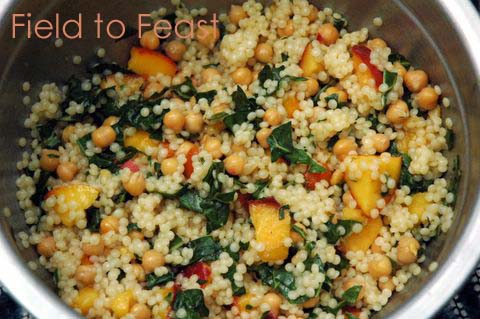
It is hot, bloody hot. The sun is doing its best to suck away my last bit of energy and the afternoon humidity has induced a permanent state of sweat. It is well past lunchtime, and I refuse to cook. Or move very much.
My only option, and a welcome one it is, is to prepare my favorite couscous salad. This dish has only one heat-inducing step – boiling the water to pour over the dry couscous. After that, all you are required to do is whisk together a Mexican-spiced dressing spiked with lime, chop up some nectarines and a handful of spinach, and open up a can of chickpeas. The nectarine cools you off, the citrus wakes you up and the whole ensemble is light and invigorating.
Serves 6 as a side dish or light lunch
1 cup uncooked (dried) couscous
1¼ cups water
4 tablespoons fresh lime juice
2 tablespoons olive oil
2 tablespoons honey
1 teaspoon salt
1 teaspoon ground cumin
1 teaspoon ground coriander
1½ cups nectarines, coarsely chopped (about 3 medium)
¾ cup coarsely chopped spinach (I used Swiss chard this time)
1 can (15½ ounces) chickpeas, rinsed and drained
Lettuce leaves, for serving
Pour the couscous into a small bowl. Bring the water to a boil and pour it over the couscous. Cover the bowl with plastic wrap or a plate, and let it sit for at least five minutes. Fluff the couscous with a fork and let cool.
Whisk together the lime juice, olive oil, honey, salt, cumin and coriander in a large bowl. Add the couscous, nectarines, spinach and chickpeas. Toss well, and serve mounded on lettuce leaves.
Saturday, October 21, 2006
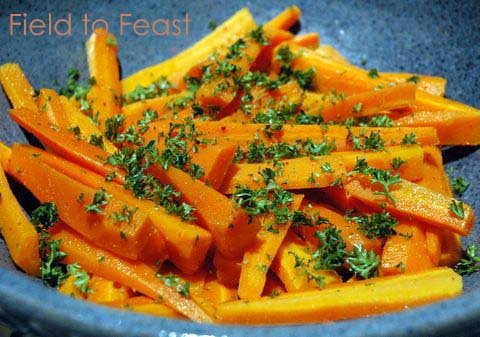
Countless Carrots? An Algerian Answer
 Your neighbor stops by with a basketful of just-picked zucchinis from her bumper crop. You return from the supermarket laden with priced-to-sell tomatoes, so bursting with juicy ripeness that you know, for sure, that the next day they’ll be rotten. Gazing at your overflowing garden, you realize that you forgot to space out the planting of your green beans, and they’ve all appeared at the same darn time. For these situations and more, everyone needs to have at their fingertips recipes that can cope with an overabundance of one particular vegetable.
Adapted from Food by Country
Serves 6
6 garlic cloves, chopped
1 teaspoon salt
½ teaspoon sugar
4 tablespoons fresh lemon juice
1 teaspoon cayenne pepper
½ teaspoon ground cumin
¼ cup fresh parsley, chopped
 Peel the carrots. Cut the skinny sections of the carrots in half lengthwise, and the fatter sections in quarters lengthwise, so that you end up with relatively uniform-width sticks approximately three inches long.
Friday, August 11, 2006
North African Salad, Yankee Sensibility
 There are three magazines I remember reading during my childhood: Ranger Rick, Yankee and Consumer Reports. The former was the one I was supposed to be reading, of course, but adults can’t keep anything out of the hands of a bookworm.
My favorite part of Yankee was its tidbits of home-spun, practical advice, typically aimed at pinching pennies or improving the quality of one’s sewing, knitting, bee-keeping or wood-working. I clearly remember one issue (circa 1988, is my guess) that described how to slice open a nearly-empty toothpaste tube in order to retrieve the last bit of paste. Otherwise, you were destined to forever forfeit that half-gram, no matter how assiduous your nightly tube rolling-and-squeezing regimen.
Consumer Reports, meanwhile, appealed to me for its scientific rigor and straightforward, confidence inspiring rating system. In fact, I felt that before my family purchased any item, we should first check Consumer Reports to guarantee we were making the best possible decision. (Okay, so I was a strange child. And I won’t even talk about my obsession with the L.L. Bean catalog).
I tell you all this because it explains why, as an adult who loves to cook, I am obsessed with Cook’s Illustrated. Cook’s Illustrated is sensible, frank and reliable, and exudes a certain Puritan minimalism that lets you know it is published in
In at least one article, Cook’s staff members present their results and recommendations from a meticulously-designed test of a certain prepared ingredient or piece of kitchenware. For example, it is because of Cook’s that I know Italian-made canned tomatoes have declined in quality since 1989 – the year when manufacturers began evading a new trade tariff by packing their tomatoes in puree rather than juice – and that a specialty tomato knife is a darn near useless piece of kitchen equipment.
Most importantly, when I am looking for a recipe that will not fail, I turn to Cook’s. So, as I mulled what new salad to attempt for Summer Salad Days (Winter Salad Days, for those of us in the Southern Hemisphere!), I logged onto the Cook’s Web site. Although the online version is not as ascetically aesthetically pleasing as the print version, it does have two distinct advantages – one, I can get my Cook’s fix anywhere in the world, and, two, the online recipes conveniently link to all related Cook’s tips. So, for example, I could link from the recipe below and discover exactly how to transform the salted nuts I had on hand into the unsalted nuts required for this recipe. (Blanch them for a minute in boiling water, then roast in a 350-degree oven until the liquid has evaporated – in case you were wondering.)
It was in Cook’s online database that I found this unique, refreshing salad recipe.
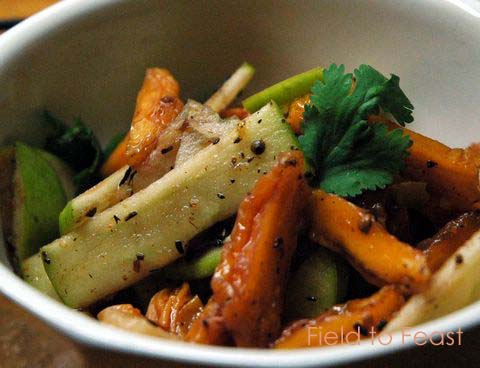
North African-style Dried Nectarine and Apple Salad
Adapted from Cook’s Illustrated
Makes about 4 cups
6 ounces (2 cups) dried nectarines, cut into 1/4-inch strips
¼ cup dry red wine
¼ cup warm water
1½ teaspoons grated fresh ginger
¼ teaspoon cayenne pepper
2 tablespoons lemon juice
2 tablespoons orange juice
2 tablespoons brown sugar
1½ teaspoons coriander seeds, toasted and ground
1½ teaspoons cumin seeds, toasted and ground
2 tart apples, sliced thin
¼ cup chopped, unsalted macadamia nuts, lightly toasted
2 tablespoons fresh cilantro leaves
Salt and ground black pepper
In medium bowl, re-hydrate peaches in wine and water for at least 15 minutes.
 Meanwhile, mix the grated ginger, cayenne pepper, lemon juice, orange juice, brown sugar, coriander seeds and cumin seeds together in the bottom of a large bowl. Toss in the sliced apples, macadamia nuts and cilantro.
The most appealing thing about this dish is its mixture of textures and colors, and the heady taste and smell of those toasted seeds and grated ginger. If you would like a slightly more demure salad, try reducing the quantities of ginger, coriander seeds and cumin seeds to one teaspoon each.
Summer Salad Days is a food blog event thoughtfully hosted by My Life as a Reluctant Housewife.


