Showing posts with label Beverages. Show all posts

Sunday, February 25, 2007

Spicing Up Your Daily Grind

In college, I made drip coffee. After college, I graduated to French press. As I turned 30, I acquired an affinity for coffee brewed in a sleek stovetop espresso-maker. One thing stayed the same – I liked my coffee dark, black and unadulterated.

Until our trip to Zanzibar. There, it is not the usual subjects – sugar and milk – that people add to their cuppa. Instead, as would befit life on the “Spice Islands,” Zanzibaris infuse their coffee with spices. Cardamom and ginger to be exact. For me, Zanzibar coffee is not everyday coffee – it can be a little too much of an event for my senses when I’m groggy and just trying to get myself out of the house. On Sundays, however, I can enjoy breathing in the aromatic steam before each sip and feeling the tickle at the back of my throat where the ginger and cardamom hit.

Zanzibar coffee is prepared similarly to Turkish or Bosnian coffee, and, like these nation’s brews, is served in tiny cups. If you choose, you can accompany your cup with a cube or two of sugar. Or, even better – and more traditional – forgo the sugar and intersperse your sipping with nibbles on a sweet, plump date.

Many people are rather protective of their morning routines, and won’t like the idea of disrupting this routine with a new method of coffee brewing. If this is you, instead of following the recipe below, try simply adding some cardamom and ginger to your normal brewing method. For example, in a French press, you can let the cardamom pods, ground cardamom and ground ginger steep along with your ground coffee. With drip coffee, make a strong brew, and then stir in the ground spices before serving. Experiment!

Zanzibar Coffee
Adapted from A Taste of Zanzibar: Chakula Kizuri
Serves 6 (small cups!)

750 milliliters / 3 cups water
3 cardamom pods
75 milliliters / 5 tablespoons ground coffee (less for weaker coffee)
2.5 milliliters / ½ teaspoon ground cardamom
2.5 milliliters / ½ teaspoon ground ginger

Boil the water for 10 minutes with the cardamom pods. Add the ground coffee, stir and boil for another five minutes. Stir in the ground cardamom and ground ginger, and remove from the heat. Pick out the cardamom pods, and serve. Like Turkish or Bosnian coffee, a bitter, coffee-grind sludge will gather at the bottom of your cup – don’t drink this!

Wednesday, January 31, 2007

Beer Brewin’

I once read that the arrival of tea on England’s shores helped fuel the Industrial Revolution. Before tea, the beverage of choice was beer, and beer-drinking was not exactly a happy accompaniment to working with machinery. Tea was. I don’t know if this story is true or not, but one thing that is true is that beer and other alcoholic beverages have been with us humans for a long, long time. In fact, our ancestors may have imbibed even more than present-day Australians. And before that very same Industrial Revolution, there was only one manner of beer and alcohol production. Whether it was brewed by monks or farmers or city-dwellers, your alcohol was home-brewed. As we all know, home-brew persists to this very day.

I, myself, have married into a celebrated homebrew tradition. My husband hails from the foothills of North Carolina – a place known for MerleFest, car racing and moonshine. In fact, he swears it was moonshine production that inspired the car racing that would become NASCAR, as moonshine brewers outraced the cops in their souped-up cars, and then began, as boys will do, to race each other.

Africa also has its indigenous brews. Talking with Zimbabweans, I don’t think I’ve heard of a grain or fruit that isn’t made into some sort of beer or liquor. What do marula fruit, mazhanje (a.k.a. loquats), palm tree sap, sorghum, millet and maize all have in common? They all can be made into alcohol. Typically this home-brewing occurs in rural areas, while urbanites drink one of several locally-bottled beers (Bohlingers, Lion, Castle, Zambezi), or the cheap favorite, Chibuku, made from sorghum and maize and sold in barrel-shaped containers. These containers are called Scuds – a name bestowed upon the product during the first Gulf War, when some (likely drunk) chap noticed that the shape of a Chibuku resembled that of a Scud missile. Strange, but true. As the economic situation here has deteriorated, the price of a Scud has rocketed out of many people’s price range (and by people, I mean men), and more and more people (and by people, I mean their wives) have begun to brew beer – even in urban areas.

With a lot of help from our housekeeper, Dorothy, this weekend we brewed chikokiyana, or one-day beer. I’m not going to write up a proper recipe (really, who among you is going to try this?), but here, for your reference, is the basic idea.

First you bring about eight cups of water to a boil. Meanwhile, in a small bowl, you mix together four wooden spoonfuls of mealie meal (the finely ground cornmeal used to make sadza) with some water to make a thin gruel. Stir, breaking up any lumps, and then pour the paste into the boiling water. Stir again, partially cover, turn the heat down to medium-high, and keep the pot at a low boil for 15 minutes.

Let the gruel cool for about five minutes, and then add another four cups or so of cold water. Stir once again to break up any lumps. Next, pour the mixture into your pfuko – the traditional round, chevron-decorated bowl with a narrow neck that is used just for this purpose. In a small bowl, mix together ½ cup raw sugar, ½ cup active dry yeast and 1½ cups chimera (fermented ground millet, or zviyo). Add to the pfuko and stir. Cover, and let sit in a warm place overnight.

Twenty-four hours later, remove the cover and watch the beer’s effervescent bubbles sputter and pop. Give the brew a stir, and then drink it straight from the pfuku. Or, if you are me, pour yourself a small glass. Chikokiyana is gritty, sour and yeasty – in other words, an extremely acquired taste. I could only get down about three sips; my husband four. Dorothy’s cousin downed the rest during the course of one day.

Apparently, you can also make a non-alcoholic version of this beverage, called mahewu by simply omitting the yeast. There is also a version of beer that is brewed for seven days and that, we hear, tastes a good bit milder than chikokiyana. I think I’ll stick to moonshine. And stay away from heavy machinery.

*Note: In keeping with the spirit of this post, I wrote it having drunk two beers (Phoenix, if you must know, the famous beer of Mauritius) on an empty stomach. Please excuse all resulting typos and errors of judgment.

Saturday, January 06, 2007

Make Hibiscus Tea (Then Vote for Me!)

This morning the weather cannot decide if it wants to be hot and sunny, cool and rainy or the pinnacle of atmospheric ambiguity – sunny and showering. I am just as restless. I made a shopping list, then decided the last thing I wanted to do was face the grocery store. Got dressed to do yoga, then plunked down on the couch. Flipped through a magazine, then tossed it aside. Began dismantling our Christmas tree, then got distracted by re-reading the cards we received.

I can’t even decide what to drink. Do I want a cup of hot tea? Or, do I want a glass of iced tea?

I better make BOTH.

The flowers of the hibiscus plant* are used in countries all around the world – from the Middle East, to North and West Africa, to the Caribbean, to Central America – to make a tangy, well-sweetened, ruby-colored tea that can be served either hot or cold. The tea is typically prepared by steeping the flowers (fresh or dried) in hot water, and then straining them out. Lots of sugar is added, and the tea is often infused with flavors that complement its cranberry-like taste, including lemon, mint, ginger, vanilla, pineapple and orange essence.

In Egypt and Sudan, the word for both the hibiscus flower and hibiscus tea is “karkaday” (or karkade). Legend has it that karakday was a favored beverage among the Pharaohs. Hibiscus flowers are known as “bissap” in Senegal and The Gambia, and the Senegalese call water infused with hibiscus flowers “jus de bissap.” For one hibiscus beverage, they mix a concentrated version of this “juice” with soda water, ginger ale or lemon-lime soda, which makes an exceptionally refreshing spritzer.

Hibiscus flowers can also be stewed to fill tarts and pies, or used to make jellies and jams. The excellent cookbook The Soul of a New Cuisine flavors then freezes hibiscus-steeped water to create a lovely, mint-garnished granitĂ©. In fact, given my current state of indecisiveness, it’s amazing that I could select tea as my preferred use of the ingredient! There are two recipes below – one for a cold Senegalese-style spritzer with vanilla accents, and one for a hot tea made with ginger and lemon.

Once you have settled down with your tea, please take a moment to check out the vast array of nominees in the 2006 Food Blog Awards. If you, like me, are having trouble making choices today, then you will be absolutely incapacitated by your voting options. Some stellar blogs have been nominated, and Field to Feast is up against tough competition in the Best Food Blog – Rural category. To check out the other nominees and cast your vote (before midnight EST on January 9!), please click here.

Iced Hibiscus Tea Spritzer
Serves 4

1 vanilla bean (you can use 2 teaspoons pure vanilla extract as a substitute)
2/3 cup sugar
2 2/3 cups water
1 cup dried hibis
cus flowers, lightly rinsed
Ice cubes
Soda water

Split the vanilla bean in half lengthwise and scrap the seeds into a small saucepan. Toss in the bean, and add the sugar and water. Stir. Bring to a boil, and then remove the pan from the heat. Stir in the hibiscus flowers and cover. Let the tea steep for 10 minutes.

Strain the liquid using a fine sieve, and then place the liquid in the refrigerator to chill. When you are ready to drink your beverage, fill four glasses with ice cubes and divide the liquid between them – each glass should be about 1/3-1/2 full. Top up with soda water and serve.

Hot Hibiscus Tea
Serves 2 (using mugs) or 3 (using teacups)

2 cups of water
½ cup dried hibiscus flowers, lightly rinsed
¼ cup sugar
¼ teaspoon grated fresh ginger
2 tablespoons fresh lemon juice
Lemon slices, for garnish

Bring the water to a boil in a small saucepan, take it off of the heat and add the hibiscus flowers. Cover the pan, and steep the tea for 10 minutes. Strain the tea using a fine sieve into a small bowl. Add the sugar, ginger and lemon juice and stir until the sugar is dissolved. Serve hot, with lemon slices.

*Technically it is the hibiscus calyx, not the flower, which is used to make tea. Also, to be precise, only one variety of hibiscus is used for culinary purposes - Hibiscus Sabdariffa, which is commonly known as roselle or red sorrel in English.

Monday, November 27, 2006

Pucker Up! A Taste of Tamarind

This past weekend I was lounging on the soft-sand, turquoise-water beach of south-east Zanzibar, equidistant from the ocean and a crystal-clear pool. There, between catnaps, I read the first few sections of John Reader’s fascinating epic Africa: A Biography of the Continent. One of the many things I learned was that humans likely evolved from primates when our ancestors began exploiting the opportunity to forage for food during the day, while most carnivores in the East African savanna were sound asleep. These daytime adventures required long hours under the hot, tropical sun, and, over time, the individuals who flourished were those who started to walk upright – which exposed less surface area to direct sunlight – and those who lost their thick coat of hair. Eventually, Reader says, we humanoids evolved to boast the most efficient cooling system of any mammal.

Very interesting stuff, and very coincidental to be reading it under that same tropical East African sun, where every move is sweat-inducing. Reader also says that the way our cooling system developed – sporting well-developed sweat glands, for example, instead of a muzzle – actually made the evolution of a large brain physiologically possible. It is this large brain that allows us to solve problems. Problems such as: My body may be an efficient cooling machine, but I feel hot. What should I do? Ah, yes, I will invent something called a refrigerator and use this nifty appliance to chill water into tiny cubes. Over these ice cubes, I will pour a beverage that will quench my thirst, give me a quick burst of energy, and jolt awake my taste buds with a puckery tang.

In other words: When in Zanzibar, I will drink tamarind juice.

The tamarind tree is native to the East African tropics. Its fruit is a long pod, and inside the pod are shiny, brown seeds surrounded by a thick, rust-colored pulp. When the pod is picked, it dehydrates into coarse, stringy fibers, which makes the tamarind that you, say, purchase at a Zanzibari market and carry with you back to Zimbabwe, distinctively unattractive (see photo). It is the pulp that you eat, and that is packaged and sold as tamarind paste.

Mark and I first drank tamarind juice during breakfast at the Tembo House Hotel on our first morning in Zanzibar. We could not stop refilling our glasses. The juice was sweet and sour with that tell-tale tamarind texture of almost syrupy thickness. Today, back in Zimbabwe, I used our “imported” fresh tamarind to make this recipe. We puckered our lips, and imagined the beach.

Tamarind Juice (Maji ya Ukwaju)
Adapted from A Taste of Zanzibar: Chakula Kizuri
Serves 8

4 cups of water, plus 3 cups
½ pound / 230 grams tamarind pods*
1¾ cups sugar

Place the tamarind pods and 4 cups of water in a large saucepan and soak the pods for one hour. Put the saucepan on the stovetop and bring the mixture to a boil. Cool.

Your next task is to remove all the stringy bits and seeds from the pan. I did this with a combination of my hands and a strainer. First, I used my hands to pick out the seeds from the pot. The membrane and any remaining pulp around the seeds should be soft and can easily be separated from the seed. Discard the seeds and return the membranes and pulp to the pan. Some seeds may have broken apart – I found that these bits are most easily captured with a fine strainer.

When all the strings and seeds are gone, use an immersion blender to blend the remaining liquid. Strain again. Add the sugar and 3 more cups of water and boil again for five minutes. Taste the liquid and add more sugar if you think it is necessary. Chill. Serve over ice cubes.

*Miriam, a Tanzanian blogger, has also recently written about tamarind juice, and she combines it with mango to create, I must say, a much more photogenic beverage. Since most people don’t have access to fresh tamarind, she helpfully recommends Laxmi Brand natural tamarind concentrate for recipes that call for tamarind, including juice recipes. Unfortunately, I don’t have any tamarind paste with me here in Zimbabwe; otherwise, I’d try making tamarind juice using the paste, and advise you on how much to use. If anyone attempts this substitute – please let me know what you discover! I’m sure your experimentation will be worth it.

Tuesday, October 03, 2006

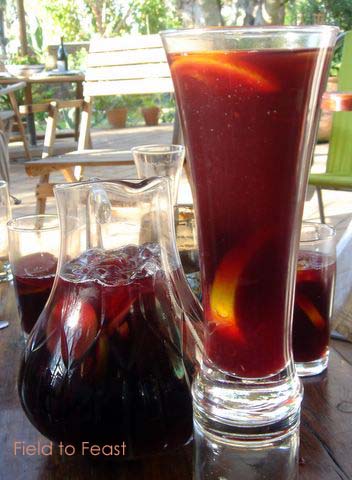
Tea, Meet Sangria

Rooibos tea – born, bred, and brewed in South Africa – is a tea full of paradoxes.

Paradox 1: Rooibos means “red bush” in Afrikaans. Yet, rooibos does not come from a red bush at all. The bush is green. The leaves of the bush turn reddish-brown only after they are fermented, which is how most rooibos leaves are processed for sale as tea.

Paradox 2: Although this dark reddish-brown tea looks as if it must contain caffeine, it is miraculously caffeine free and, healthier still, is chock full of antioxidants. This makes rooibos the ideal beverage for kicking your caffeine habit. (If you want the habit to be kicked, that is. I like mine very much, thank you.)

Paradox 3: Rooibos is not a tea at all. Technically, it is an herb. (It is also a member of the Cape floral kingdom, which is located in southwestern South Africa, in and around the city of Cape Town. The Cape floral kingdom is the smallest of the world’s six floral kingdoms, and is also the most species-packed. In fact, Table Mountain, which forms the stunning backdrop to Cape Town’s skyline, supports more flora species than the entire United Kingdom.)

Paradox 4: Rooibos was first drunk in tea form thousands of years ago by the Khoisan people, the original inhabitants of large swaths of southern Africa. They introduced it to subsequent arrivals to the region, but it was not very popular. In recent decades, however, rooibos has become one of those patriotism-inspiring products that South Africans proudly claim as their own. In fact, it is almost trendy, and posh South African coffeehouses are now serving rooibos espresso.

I enjoy rooibos’ mellow, slightly-sweet, slightly-nutty flavor in a simple cup of hot tea or glass of iced tea. Or, twist my arm, on a sunny afternoon I like rooibos in this refreshing, non-cloying version of sangria. Tea? Sangria? No paradox there.

Rooibos Sangria
Adapted from Food and Home Entertaining, June 2004
Makes about 8 cups

2 cups water
4 teaspoons rooibos tea leaves
½ cup sugar
2 cinnamon sticks
3 cups red wine
½ cup brandy
2 cups apple juice
1 orange, sliced
1 apple, sliced
Ice cubes

Bring the water to a boil in a medium saucepan. Add the tea leaves, sugar and cinnamon sticks, and give the pot a stir. Turn the heat down to medium and simmer for 10 minutes. Strain the mixture to remove the tea leaves and cinnamon sticks. (It’s okay if a few tea leaves slip through). Put the liquid in the refrigerator, and chill. This will take about an hour or so.

Add the red wine, brandy, apple juice, orange slices and apple slices. Stir. Serve with ice cubes.

Saturday, August 19, 2006

A Drink, Tall and Gingery

Stoney is back!” Mark shouted with glee from the other end of the supermarket aisle. I abandoned our cart, rushed to the refrigerated section, and saw that it was true. There, resting innocuously behind the refrigerator door were rows and rows of our favorite soda – Stoney Ginger Beer.

Like fuel, bread and sugar, soda is prone to shortages in Zimbabwe. In fact, one month last year, soda disappeared from store shelves entirely. So we weren’t surprised when Stoney vanished several weeks ago. We just hoped its return would be imminent.

Stoney was introduced in South Africa in 1971, and is now one of Coca-Cola’s more than 400 brands. Ginger beer itself has a much longer history. The drink was first brewed in England in the 1700s, and contained a considerable amount of alcohol. It is traditionally made by using a “ginger beer plant” – not a plant at all, but an ever-growing mixture of microorganisms that produce carbon dioxide and alcohol. Today, mass-produced ginger beer like Stoney or Bundaberg is carbonated without fermentation, so it is non-alcoholic. Unlike its close cousin ginger ale, ginger beer is typically cloudy.

The Stoney Ginger Beer we drink is bottled in Harare. Yes, I said BOTTLED. Almost all soda here comes in actual glass bottles, which you later return for a refund. The bottles that contain Stoney do double duty – Stoney’s old-timey label is on one side, and the label for a hideous chartreuse drink called Sparletta is on the reverse. Woe to the person who thinks they spot Stoney at the store, only to discover it is the dreaded Sparletta.

On a “ginger-bite” scale from Schweppes to hot Blenheim Ginger Ale, Stoney is a 7. Stoney won’t clear your sinuses like a sip of Blenheim, but it is much more drinkable and has a very satisfactory ginger tang. Although Stoney does not need any accompaniments, today I decided to celebrate its return to our refrigerator by testing a recipe I spotted in Food and Home Entertaining. I didn’t think it was possible, but this gingerade is even more refreshing than Stoney solo.

Gingerade
Adapted from Food and Home Entertaining, May 2006
Serves 4 (or 2 very thirsty people)

500 milliliters / 2 cups ginger beer, chilled
500 milliliters / 2 cups peach (or apricot) juice, chilled
Juice of half a fresh lime (or lemon)
150 milliliters / 2/3 cup brandy (optional)
Ice

In a pitcher, combine the ginger beer, juices and brandy. Stir to combine. Add a handful of ice cubes and serve immediately.

For those of you who live outside of southern Africa…well, you are far, far away from Stoney Ginger Beer. In the States, try to make this drink with Blenheim’s mild ginger ale. If you must use a standard ginger ale (like Schweppes or Canada Dry), try amplifying the ginger flavor by adding some shavings of fresh ginger.