Showing posts with label Breakfast. Show all posts

Tuesday, January 01, 2008

The Red and Green Gimmick

When my husband and I first moved into our furnished rental house in Harare, we discovered a heart-shaped plaque on the wall that featured two kissing mice and the slogan "mouse-to-mouse resuscitation." We took it down. Immediately. And hid it in the farthest corner of the closet. I am not a fan of the tacky or the twee.

I do, however, take pleasure in the occasional gimmick. Gimmicky is at the seedier end of the tacky-classy spectrum, I’ll admit; although I hope you’ll agree that it doesn’t quite approach the excess of plastic mice attempting to cutely feign a life-saving procedure. Predictably, my gimmicks typically enlist the assistance of food and drink. I’ve dyed cookies all colors of the rainbow to match holiday hues. In college, my roommate and I turned our apartment’s thermometer up to 80 and held a July in Winter party, complete with umbrella-ed margaritas. A year-and-a-half ago, when the Zimbabwean government dropped three zeros from the currency, my husband and I hosted a “zeroes” fiesta featuring zero-shaped food, including bagel pizzas. And, over the past two weeks, I have been obsessed with preparing red and green food. Roasted red pepper soup with a dollop of avocado cream for garnish? Made it. Spinach lasagna? Check. Watermelon and feta salad with mint? Yep. And, for breakfast on Christmas morning, testira (sometimes written tastira) – a Tunisian egg and pepper dish. Red and green peppers, of course.

Although some recipes call for the egg in testira to be poached, the egg is scrambled in the recipe I use from Kitty Morse’s The Vegetarian Table: North Africa. In any case, the egg is really beside the point because what makes this dish a standout are the peppers – roasted until sweet and spiked with harissa (also spelled harisa), a traditional Tunisian condiment of chilies, garlic, spices and olive oil that makes you breathe like a dragon.

Testira is typically served as an accompaniment to fish. My taste buds have a difficult time imagining how this combination works, although I certainly don’t doubt the flavor amalgamation skills of the people who brought us tabil and chakchouka. Fish and testira might be one of those things I’ll just need to try someday in Tunisia. In the meantime (and this could be a very long meantime), I think testira stands up for itself quite well as a breakfast centerpiece.

Hmm….maybe I could have a party where the gimmick is that everyone brings a food combination that they like, but that other people think is strange; or maybe the gimmick could be egg dishes from around the world, or maybe…

Testira
Adapted from The Vegetarian Table: North Africa
Serves 3 as a main dish

2 red bell peppers
2 green bell peppers
1 red or green chili pepper
4 large tomatoes
2 tablespoons / 30 milliliters olive oil
2 teaspoons / 10 milliliters ground coriander
Salt and freshly ground black pepper, to taste
4 eggs, lightly beaten
1 teaspoon / 5 milliliters harissa (See note below)

Roast the peppers and the tomatoes, using the roasting method you prefer. Here’s what I do: I preheat the oven to 190°C (375°F) and put the vegetables on one tray, with the tomatoes on a piece of aluminum foil with the edges rolled up so that the juices they emit during roasting don’t spread. Place the tray on an oven rack near the top. Turn the peppers every 5-10 minutes. The chili pepper will only take about 20-25 minutes to roast. The tomatoes and peppers will take about 35-40 minutes. The peppers are done when their skins have blackened and separated from their flesh.

Set aside the tomatoes to cool. Place the peppers in a glass or ceramic bowl and cover with a plate. When the peppers are cool enough to handle, peel and seed them, and cut them into 1-inch (2.5-centimeter) pieces. When the tomatoes are cool enough to handle, peel, seed and chop them.

In a large skillet over medium heat, heat the olive oil. Add the tomatoes and cook, stirring occasionally, until the tomatoes break down and thicken a bit – about 5-6 minutes. Add the peppers and cook, stirring occasionally, for 10-12 minutes. Stir in the coriander, salt, pepper and harissa. Add the eggs and stir gently until they are cooked. Serve immediately with toast and some extra harissa on the side for those who like spice!

Note: I’ll write about harissa in a future post. In the meantime, in some countries you can find prepared harissa in a jar at the store. These two recipes also look quite good, and are similar to the Madhur Jaffrey recipe that I use. If you don’t have harissa, you can add a teaspoon of chili powder when you add the ground coriander, although it won’t pack the same punch.

P.S. Happy 2008!

Wednesday, August 23, 2006

Wake Up! Your Rusks Are Ready

I was born in South Africa and am a cross between biscotti and a granola bar. Preparing me requires the patience demanded by meringues, along with the “no, don’t eat it yet” willpower of raw cookie dough. What am I?

Why a rusk, of course. Rusks are hard, dry biscuits – perfect for dipping in tea or coffee. This twice-baked breakfast staple is one food expatriate South Africans long for, and insist that visitors bring them. Tradition says rusks were invented by early travelers and explorers who needed foods that wouldn’t spoil.

In the rusk recipe below, the active steps are interspersed with periods of waiting while the dish bakes or cools. That means you’ll want to prepare rusks when you’ve already planned on spending a couple hours in the kitchen, or on a lazy weekend afternoon when you need to get up periodically to refill your lemonade anyway. As the title of this post suggests, the final product will not be ready until the following morning, after a night of drying in a barely-warm oven. Also, note that the original recipe uses milliliters and grams. I’ve converted the milliliters, but it’s best to use a kitchen scale to measure out the grams. Or, for approximate gram conversions, you can use this site as a resource.

Four-Seed Whole-Wheat Rusks
Adapted from Food and Home Entertaining, July 2002
Makes 48

500 grams whole-wheat flour
140 grams cake flour
5 milliliters / 1 teaspoon salt
30 milliliters / 2 tablespoons baking powder
200 grams treacle sugar (you can substitute molasses, or light or dark corn syrup)
250 grams butter, at room temperature
50 grams desiccated coconut
80 grams oats
80 grams sunflower seeds
30 grams poppy seeds
30 grams linseeds (a.k.a. flaxseeds)
50 grams sesame seeds
500 milliliters / 2 cups buttermilk
250 milliliters / 1 cup water
2 jumbo eggs, lightly beaten

Line a 39 x 32 x 4 centimeter (approx. 15 x 19 x 2 inch) baking tray with baking paper, and pre-heat your oven to 180 degrees Celsius (360 degrees Fahrenheit).

In a large bowl, sift together the whole-wheat flour, cake flour, salt and baking powder. If some bran husks remain in the bottom of your sifter, return them to the bowl. Add the treacle sugar, and stir. Dice the butter over the flour mixture and rub it in with your fingers. Then add the coconut, oats and all of the seeds, and mix well.

In a medium bowl, combine the buttermilk, water and eggs. Beat lightly with a fork, and add to the batter. Using a large metal spoon, gently fold in the liquid.

Spoon the dough into the prepared baking tray and cover with aluminum foil. Bake for 30 minutes at 180 degrees (360 F). Then, remove the foil and reduce the temperature to 160 degrees (320 F). Bake until a toothpick inserted in the middle comes out clean, about 30-40 minutes.

Remove the tray from the oven and cool completely. This step requires substantial willpower because what you have in front of you looks and tastes like a bran muffin cake. Write “bran muffins” down on your list of things to bake next weekend, and leave the poor rusks-to-be alone.

The next step is to cut the tempting muffin cake into 8 x 3 centimeter (approx. 3 x 1 inch) rectangles. You can do this while it is still in the tray, or you can turn the cake out onto a solid surface. Arrange the rectangles on oven racks, spaced slightly apart so that the dry, barely-warm air can circulate. Dry overnight for 12 hours at 50-60 degrees (130-140 F), keeping the oven door closed.

Open the door in the morning, and admire your rusks for a moment. They should be very dry and dense. Serve with your wake-up tea or coffee. Cool and store the remaining rusks in an airtight container. They will keep for weeks.

What a better way to start your day?

Saturday, July 29, 2006

Make Mine Mawuyu

Perhaps you read Le Petit Prince as a high-school French student, or its English translation, The Little Prince, as a child. If so, then you are already familiar with the unmistakable "upside-down" shape of the baobab tree. Far, far from Saint-Exupéry's make-believe asteroid, the tree's broad, thick trunk and comparatively spindly branches can also be seen dotting the hot, dry savannas of Africa and Australia. Unlike its literary incarnation as a promulgating pest, the real-life baobab is one of the most useful trees on the planet. Its leaves, seeds, fruit, bark and trunk can all serve human purposes, from food to clothing to medicine to shelter. Just been shot by a poisonous arrow? Neutralize the toxins with baobab extract. Pantry out of cream of tartar? Try the pulp of the baobab fruit as a substitute. This fruit pulp can also make a tasty, lemon-scented porridge, which is how, today, I ate my very first baobab by-product.

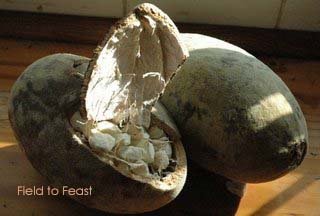
A month ago, Sampson, our basket-weaving friend, brought us two baobab fruits from his rural home. They were the color of pâté and shaped like ostrich eggs. The skin was hard and coated with a velvety fuzz. Mark and I could pick up the fruits and give them a very satisfying, maraca-like shake. Beyond that, we had no idea what to do with them. So, they sat on our countertop. And sat and sat and sat.

This morning, Dorothy suggested that baobab pulp would make an excellent addition to our cream-of-wheat. After chuckling at my proposal to cut the baobab open with a knife, she picked one fruit up and smashed it several times against the brick wall. Inside the thick, fibrous shell was some pale-yellow powder, most of it encrusted around pellet-sized black seeds. With Dorothy’s encouragement, we popped the seeds in our mouths – the taste reminded us of a mild lemon sourball. We scooped out about half a cup of the pulp and seeds from the fruit, and added it to 3 cups of just-about-to-boil milk, along with a pinch of salt and a generous 2/3 cup of cream-of-wheat. After a few minutes of stirring, we had a creamy porridge, ready to serve with a dollop of honey.

If, to your mind, seeds suck all the joy out of a plump, juicy grape, then I'll have an uphill battle convincing you of the benefit of tossing baobab seeds in your porridge. And if cream-of-wheat is a dish you only plan to resort to when your teeth fall out, then I probably should have warned you to avoid reading this entry in the first place. Otherwise, trust me – the baobab seeds act as a thickener and the pulp adds a ton of Vitamin C to your breakfast meal, along with a light lemon flavor. Baobab fruit will no longer sit and sit and sit on our counter.

This post is an entry in Weekend Breakfast Blogging, excellently hosted by Saffron Trail.